

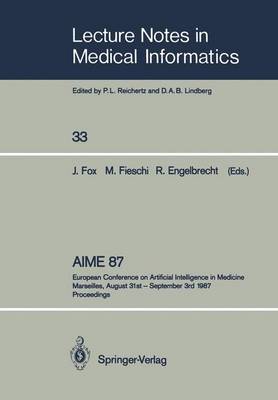
AIME 87: European Conference on Artificial Intelligence in Medicine Marseilles, August 31st – September 3rd 1987 Proceedings
Synopsis
The current scarcity of expert systems where the reasoning is based on Bayesian probability theory may be due to misconceptions about probabilities found in the literature. As argued by Cheeseman (1985), these misconceptions have led to the attitude: "The Bayesian approach doesn't work - so here is a new scheme". Several of these expert systems based on ad hoc "probability" concepts have been successful in a number of ways, demonstrating the necessity of being able to handle uncertainty in medical expert systems. They also demonstrate the need for a theoretically sound handling of uncertainty. In Andersen et al. (1986) it was postulated that knowledge organized in a causal network can be used for a unified approach to the main tasks of a medical expert system: diagnosis, planning of tests and explanations. The present paper explores this postulate in a causal probabilistic network. It also provides a practical demonstration that the problems supposedly associated with probabilistic networks are either non-existent or that practical solutions can be found. This paper reports on the methods implemented in MUNIN* -an expert system for electromyography (EMG) (Andreassen et al. 1987). EMG is the diagnosis of muscle and nerve diseases through analysis of bioelectrical signals from muscle and nerve tissue. In Andreassen et al.
Publisher information
- Publisher: Springer-Verlag Berlin and Heidelberg GmbH & Co. KG
- ISBN: 9783540184027
- Number of pages: 255
- Dimensions: 244 x 170 mm
- Languages: English
Customer Reviews
You may also like...