


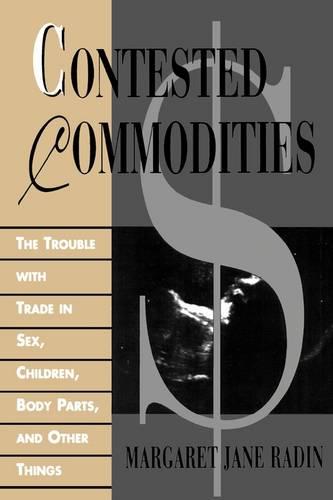
Contested Commodities
Synopsis
Not only are there willing buyers for body parts or babies, Radin observes, but some desperately poor people would be willing sellers, while better-off people find such trades abhorrent. Radin observes that many such areas of contested commodification reflect a persistent dilemma in liberal society: we value freedom of choice and simultaneously believe that choices ought to be restricted to protect the integrity of what it means to be a person. She views this tension as primarily the result of underlying social and economic inequality, which need not reflect an irreconcilable conflict in the premises of liberal democracy.
As a philosophical pragmatist, the author therefore argues for a conception of incomplete commodification, in which some contested things can be bought and sold, but only under carefully regulated circumstances. Such a regulatory regime both symbolizes the importance of nonmarket value to personhood and aspires to ameliorate the underlying conditions of inequality.
Publisher information
- Publisher: Harvard University Press
- ISBN: 9780674007161
- Number of pages: 296
- Dimensions: 235 x 156 x 19 mm
- Weight: 431g
- Languages: English