

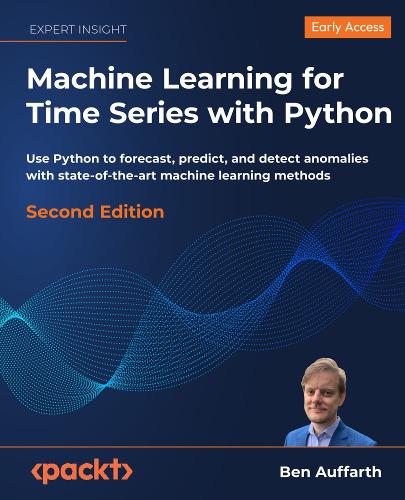
Machine Learning for Time Series with Python: Use Python to forecast, predict, and detect anomalies with state-of-the-art machine learning methods
Synopsis
Get better insights from time-series data and become proficient in building models with real-world data
Key Features
Explore time series forecasting and time series analysis in Python using ARIMA, SARIMA, GARCH, gradient boosting, and recurrent neural networks.
Improve predictive modeling with feature engineering and forecasting machine learning techniques.
Apply demand forecasting and financial forecasting methods through practical case studies and real-world datasets.
Book DescriptionThe Python ecosystem offers a wide range of tools for time series analysis and time series forecasting. Machine Learning for Time Series, Second Edition provides a practical guide to building forecasting systems while developing a solid understanding of modern predictive modeling techniques.
Starting with the fundamentals of time series data, you'll learn how to prepare datasets, perform feature engineering, and build forecasting pipelines. The book covers traditional methods such as ARIMA, SARIMA, and GARCH, alongside machine learning approaches including gradient boosting, recurrent neural networks, and deep learning models.
Through practical examples and clear explanations, you'll learn how to choose the right model for the right problem and improve forecasting accuracy across multiple applications. Updated content includes forecasting and signal extraction for financial markets, plus case studies from operations management, digital marketing, healthcare, and financial forecasting.
By the end of this book, you'll be able to confidently perform time series analysis and build effective forecasting systems using Python.What you will learn
Visualize time series data with ease
Characterize seasonal and correlation patterns through autocorrelation and statistical techniques
Get to grips with classical time series models such as ARMA, ARIMA, and more
Understand modern time series methods including the latest deep learning and gradient boosting methods
Choose the right method to solve time-series problems
Become familiar with libraries such as Prophet, sktime, statsmodels, XGBoost, and TensorFlow
Understand both the advantages and disadvantages of common models
Evaluate high-performance forecasting solutions
Who this book is forThis book is ideal for data analysts, data scientists, and Python developers who want instantly useful and practical recipes to implement today, and a comprehensive reference book for tomorrow. Basic knowledge of the Python Programming language is a must, while familiarity with statistics will help you get the most out of this book.
Publisher information
- Publisher: Packt Publishing Limited
- ISBN: 9781837631339
- Dimensions: 235 x 191 mm
- Languages: English
Customer Reviews
You may also like...