

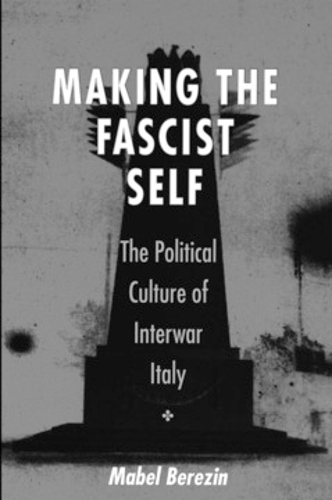
Making the Fascist Self: The Political Culture of Interwar Italy
Synopsis
In her examination of the culture of Italian fascism, Mabel Berezin focuses on how Mussolini's regime consciously constructed a nonliberal public sphere to support its political aims. Fascism stresses form over content, she believes, and the regime tried to build its political support through the careful construction and manipulation of public spectacles or rituals such as parades, commemoration ceremonies, and holiday festivities.
The fascists believed they could rely on the motivating power of spectacle, and experiential symbols. In contrast with the liberal democratic notion of separable public and private selves, Italian fascism attempted to merge the public and private selves in political spectacles, creating communities of feeling in public piazzas. Such communities were only temporary, Berezin explains, and fascist identity was only formed to the extent that it could be articulated in a language of pre-existing cultural identities.
In the Italian case, those identities meant the popular culture of Roman Catholicism and the cult of motherhood. Berezin hypothesizes that at particular historical moments certain social groups which perceive the division of public and private self as untenable on cultural grounds will gain political ascendance. Her hypothesis opens a new perspective on how fascism works.
Publisher information
- Publisher: Cornell University Press
- ISBN: 9780801484209
- Number of pages: 288
- Dimensions: 229 x 152 x 21 mm
- Weight: 454g
- Languages: English
Customer Reviews
You may also like...