


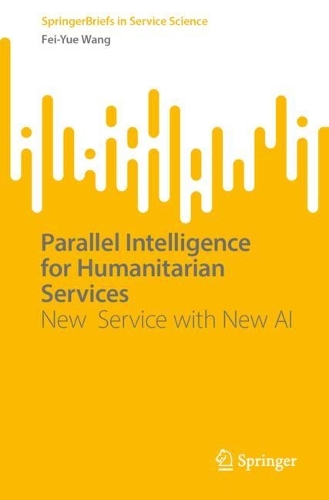
Parallel Intelligence for Humanitarian Services: New Service with New AI
Synopsis
This book explores the transformative potential of parallel intelligence in enhancing humanitarian services for sustainability, with a focus on leveraging the latest advancements in artificial intelligence. It brings together cutting-edge technologies like agentic intelligence, autonomous intelligence, Retrieval-Augmented Generation (RAG), and Search-Augmented Generation and Extension (SAGE), and along with digital human technologies, to reimagine and re-optimize service systems across a range of sectors. It examines how these technologies can transform service systems across diverse sectors, including education, healthcare, emergency management, agriculture, tourism, and ecology. By integrating real-time data, AI models, and feedback loops, the book outlines how these parallel systems can improve the effectiveness, resilience, and sustainability of services. It also highlights the role of blockchain, smart contracts, and Decentralized Autonomous/Agentic Organizations (DAO) in optimizing distributed humanitarian operations. As AI continues to advance, the author raises the crucial question of what the best model for sustainable and reliable humanitarian services should look like. Through this exploration, he argues that parallel intelligence offers new, innovative solutions to address global challenges, making service systems more adaptive and efficient.
This book appeals to a broad audience, including academics, researchers, data scientists, practitioners, students, educators, and general public interested in the intersection of service science and AI. It offers critical insights and practical strategies, making it a valuable resource for those working in scientific research for services, LLMs, and the development of intelligent systems.
Publisher information
- Publisher: Springer Nature Switzerland AG
- ISBN: 9783032351258
- Dimensions: 235 x 155 mm
- Languages: English