

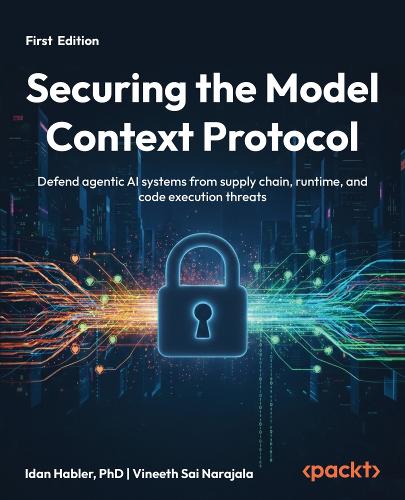
Securing the Model Context Protocol: Defend agentic AI systems from supply chain, runtime, and code execution threats
Synopsis
Learn to build and secure MCP servers for agentic AI systems by translating real-world threat models into OAuth 2.1, sandboxing, RBAC, and supply chain defenses that work in production.
Key Features
Threat-model MCP systems across supply chain, runtime, and code-mode attack surfaces
Implement OAuth 2.1, RBAC, tenant isolation, and policy-first authorisation for MCP
Harden MCP servers with sandboxing, validation, monitoring, and supply chain controls
Book DescriptionAs agentic AI shifts from text generation to operational roles, it relies on the Model Context Protocol (MCP) to interface with databases and execute code. While MCP provides essential connectivity, it introduces a sophisticated attack surface. Securing MCP offers a hands-on framework for protecting these autonomous systems throughout their lifecycle.
The book begins by deconstructing MCP architecture to establish a rigorous threat model, categorizing risks across supply chain integrity, runtime execution, and "code-execution" attack vectors. Readers will learn to map these vulnerabilities to testable security controls that mirror adversary behavior. It then details the technical implementation of OAuth 2.1 and scoped authorization, ensuring every interaction is authenticated and auditable.
Beyond identity, the guide explores specialized threats like prompt injection, tool poisoning, and "rug pull" malicious updates. For enterprise production, it covers deployment hardening - including sandboxing, I/O validation, and secrets management - before addressing governance through RBAC, policies, and human-in-the-loop (HITL) mechanisms.
Complete with Python implementations and verification checklists, this book provides the professional roadmap required to deploy agentic AI with institutional-grade security.What you will learn
Design and secure MCP servers for both local and remote agentic deployments
Detect and mitigate agent-native attacks such as prompt injection and tool poisoning
Sandbox MCP tool execution using containers, gVisor, and Firecracker-style isolation
Secure higher-risk MCP patterns, including remote execution and code-mode servers
Harden the MCP supply chain using signing, verification, and dependency controls
Establish monitoring, governance, and human-in-the-loop approval workflows
Who this book is forThis book is for software engineers, security engineers, platform architects, and DevSecOps practitioners who are building, deploying, or securing MCP-based agentic AI systems. It’s also useful for AI/ML engineers integrating third-party MCP servers, security teams assessing agentic AI risk, and engineering leaders defining governance and control requirements for tool-connected assistants. Familiarity with Python, REST APIs, and OAuth is helpful, but not required - core concepts and security patterns are introduced and explained as you go.
Publisher information
- Publisher: Packt Publishing Limited
- ISBN: 9781807307578
- Dimensions: 235 x 191 mm
- Languages: English
Customer Reviews
You may also like...