

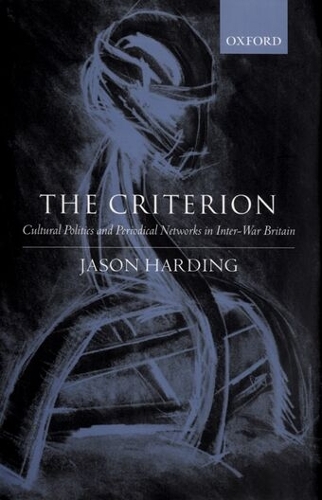
The Criterion: Cultural Politics and Periodical Networks in Inter-War Britain
Synopsis
In this detailed study of literary culture in the inter-war period, Jason Harding examines the standing of T. S. Eliot's journal the Criterion in relation to other literary periodicals and, beyond that, to the larger cultural networks of the time. The Criterion may at first sight seem a well-studied publication, often dismissed as predictably conservative, even proto-Fascist. However, through his examination of insufficiently known archive material and interviews with living witnesses to the period, Harding significantly alters our understanding of the journal and of Eliot's role as editor. More than that, by carefully resituating the journal in its relations - of both competition and co-operation - with a range of other literary periodicals (for the most part little-studied themselves), he shows himself an authoritative and discriminating guide to the often complex networks within which Eliot worked. The Criterion: Cultural Politics and Periodical Networks in Inter-War Britain defends the journal against charges of Fascism and anti-Semitism: it is an invaluable book for scholars of Eliot and an original and incisive exploration of difficult areas of literary-cultural exchange.
Publisher information
- Publisher: Oxford University Press
- ISBN: 9780199247172
- Number of pages: 268
- Dimensions: 224 x 146 x 19 mm
- Weight: 413g
- Languages: English

You may also like...