


Chloe Michelle Howarth Q&A
A creeping story of sibling rivalry and sapphic obsession with gothic undertones set in 1960s rural Ireland. Chloe Michelle Howarth's second novel is already one of our booksellers favourite novels of the year. Some of them were lucky enough to put questions to the author about Heap Earth Upon It and her brilliant debut Sunburn.
'A devastating mix of hope and heartbreak, from one of Ireland's most exciting queer voices'
- Niamh Ní Mhaoileoin
'I lost myself in Chloe Michelle Howarth's strange and startling second novel. It's a deeply affecting tapestry of gothic landscapes and virtuosic, character driven prose. As it haunted me, Heap Earth Upon It will haunt you too.'
- Lucy Rose
Chloe Michelle Howarth Q&A
Do you have a song you associate with Sunburn or any music you listened to when writing it?
Chloe Michelle Howarth: So many! I made a playlist of the main songs that I had on repeat while writing it, whenever I hear them I feel so connected to the story and characters again. The main ones for me are Slow Dancing by Aly & AJ, You Stupid Bitch by Girl in Red, and Bad as the Boys by Tove Lo. Also, honorary mention to Good Luck, Babe.
Both of your novels are set in Ireland and it feels like place is very important to you in your writing. Is setting them in Ireland an important choice for you and if it weren’t Ireland, where else could you imagine setting a novel?
CMH: I really enjoy writing about Irish towns, the culture and the people. Especially in a queer context. It’s important to me to write explicitly queer stories set in rural Ireland, because there are plenty of queer people there, and its representation I didn’t have growing up. Also I think it’s something I can portray somewhat accurately, where if I was setting a story in another country I’d feel a bit nervous about capturing an authentic voice/experience for the characters. I’ve lived in Brighton for a few years, so I might like to try setting something here one day!
“It’s important to me to write explicitly queer stories set in rural Ireland, because there are plenty of queer people there, and its representation I didn’t have growing up.”
Who would your dream casting be for the 'Sunburn' cast if it were to be adapted for TV or film?
CMH: As the book is set in a fictional town in Cork, I’d love to have actors from Cork, just because I think the accent is so hard to get right!
In what ways did you find the gothic elements of 'Heap Earth Upon It' to be deepened by the context of Irish landscape and culture?
CMH: Initially, my aim was to move away from the sunny, sweet vibes of Sunburn. I found that the darker colour palette, winter season, and deep rural setting was the perfect way to do that. I think that the bare trees, grim weather, long nights that are so typical in an Irish winter are perfect for a more gothic story, they go hand in hand.
In 'Sunburn', you explored the role of parents in nurturing a child’s potential and supporting them, and their role in perpetuating ideologies of shame around sexuality, particularly between mothers and daughters. What led you to exploring this experience of parental absence through a gothic lens?
CMH: I didn’t expect to have the theme of mother/child relationships come up again in my second book, although it is in quite a different way this time. I think when writing characters who are deeply affected by the expectations put on them by their gender, it would be difficult not to examine who their parents are and the relationship they share. It gives a deeper insight into why people are the way they are. As for the gothic element, the book was already headed in quite a gothic direction before the parental theme was introduced, and in the end I think both themes ended up intensifying each other.
“I think when writing characters who are deeply affected by the expectations put on them by their gender, it would be difficult not to examine who their parents are and the relationship they share.”
As your first novel achieved a lot of (well deserved) attention and acclaim, how was writing a second novel off the back of this different? Did you find it hard to move on from your first novel and discover something new?
CMH: I was quite keen to move away from Sunburn when starting the second book, just as I wanted to prove to myself that I was able to do something different. It was daunting because I know that Sunburn is special to readers, and I knew this was going to be quite far from that world. But I loved doing something new, and it was good to figure out what parts of my writing style could be carried over, and what belong only in Sunburn. Doing something new has made me a more confident writer.
Have you ever considered writing a continuation of Lucy and Susannah's story?
CMH: I’m 50/50 about it! Part of me wants to leave them in peace after all the turmoil they went through in Sunburn, but I’m always open to the idea of coming back to them. I like the idea of revisiting their story every ten years and seeing what might have happened.
'Sunburn' and 'Heap Earth Upon It' are quite different vibes, which one did you enjoy writing more and how did the writing process differ?
CMH: I can’t say that I enjoyed writing one more than the other, although it’s true that the experiences of writing them were very different. Sunburn was written in Ireland during lockdown, so I had a lot of time, and the inspiration was all around me. Where I wrote Heap Earth Upon It in a flat in England while I was working full time. It’s hard to compare the two! I really loved writing both of them in different ways, and I’m glad I got a chance to write them both.
What book would you recommend for the Lucy and Susannah shaped holes you've left in our hearts?
CMH: Now You See Me edited by Jane Traies is a beautiful collection of biographies of queer women spanning from the 1940s to 2010s. Heartwarming and heartbreaking, it gives a look into what life was like for lesbians at different times in history.
Where do you envisage Lucy and Susannah now?
CMH: That’s really up to each individual reader, but hopefully they would be happy and very proud of who they are.
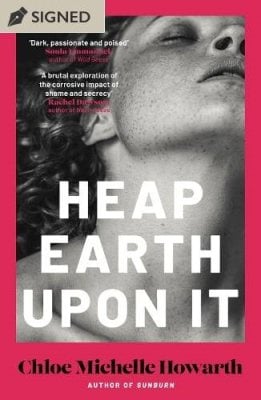 Heap Earth Upon ItChloe Michelle HowarthPrice: £16.99Set in 1960s Ireland, the second novel from the author of the bestselling Sunburn is a poignant and beautiful meditation... See moreSet in 1960s Ireland, the second novel from the author of the bestselling Sunburn is a poignant and beautiful meditation on life lived under the weight of secrets, as three orphaned siblings... See more
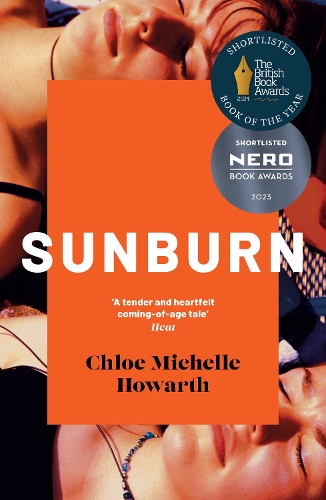 SunburnChloe Michelle HowarthPrice: £10.99Richly evocative of early 1990s small-town Ireland, Howarth's fine debut centres on the forbidden relationship between L... See moreRichly evocative of early 1990s small-town Ireland, Howarth's fine debut centres on the forbidden relationship between Lucy and Susannah and the double life both are forced to lead as the pr... See more
 Heap Earth Upon ItChloe Michelle HowarthPrice: £16.99Set in 1960s Ireland, the second novel from the author of the bestselling Sunburn is a poignant and beautiful meditation... See moreSet in 1960s Ireland, the second novel from the author of the bestselling Sunburn is a poignant and beautiful meditation on life lived under the weight of secrets, as three orphaned siblings... See more

Chloe Michelle Howarth was born in July 1996. She grew up in the West Cork countryside, which has served as an inspiration for her writing. Chloe currently lives in Brighton. Her debut novel, Sunburn, was shortlisted for the 2024 Polari First Book Prize, the 2024 Book of the Year: Discover Award at the British Book Awards and the 2023 Nero Book Award for Debut Fiction and longlisted for the 2024 Diverse Book Awards.