



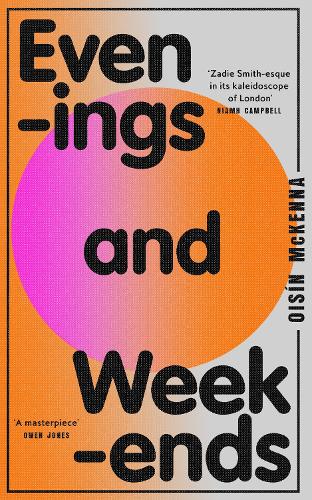
With his debut phenomenon Evenings and Weekends hot off the press, we asked Oisín McKenna to share with us how he does what he does. Set over a weekend in London 2019, in the throes of a heatwave, Evenings and Weekends follows a group of young adults navigating love, sex and the search for meaning in the modern metropolis. McKenna captures time and place perfectly, and the characters are vividly drawn, making this a debut that will stick with you a long time after reading.
How I Write by Oisín McKenna
Part of why I’m drawn to stories about London is because the density of history here. You can stand on any street corner in London, observe all the people and sounds and architectural styles, and tell an epic multi-generational saga which requires only five minutes and a small geographical expanse. I wrote Evenings and Weekends partly as a way to tell a rich and sprawling story about how London’s politics and culture and emotional textures and sensory detail can congeal in the lives of a broad cast of characters. I started working on the book in early 2019. I’d been living in London for a little over a year and I was very excited by the expanded sense of possibility that sometimes took hold during the summer and during the weekend. Normal life became a little slippery and it felt like some huge life-changing event could take place at any moment. The life-changing event nearly never actually materialised but it was a pleasurable feeling to be suspended in longing for it. I was interested in writing a book that captured that feeling, but in concrete and material terms: what were the political barriers towards the realisation of London’s promises? The characters are all in pursuit of something, but it's not meaning: what they want and need more than anything is money, freedom from precarity which would in turn allow their dreams in London to unfold.
One of the challenges of writing an urban community novel which follows the intersecting lives of a broad cast of characters is that it involves writing about people who are unlike you in terms of demographic detail, even as they may be similar to you in other personality traits. There are political dimensions to this question - am I overstepping the mark? Am I speaking from perspectives that I have no right to speak from? - and it poses artistic and narrative questions too: can I write these stories in convincing ways? Will the limits to my own subjectivity prevent me from compellingly capturing the subjectivity of someone else? For example, one of the book’s main characters – and in many ways, the hero of the story – is Rosaleen, a sixty-year-old woman, a mother, who has been diagnosed with cancer. I’m thirty years younger than her, a different gender, and grew up in a very different context. I have not had children and have not had cancer. These are key differences and choosing to write a character like this meant that I, and the people around me, had to be quite honest about how sensitively I could write this character. When approaching a character who is different from myself in key demographic ways, I approached it by imagining the ways that we were similar. Because in many ways, Rosaleen is one of the characters who I most resemble. She’s shy, she’s ill at ease in her body, she struggles to say what she means. We’re both Irish migrants with a complicated relationship to both Ireland and the UK. Many of the things she thinks and feels are things that I think and feel too, and there are so many key passages about her which began life in my own journal, describing my own desires and dreams and fears. For example, there’s a passage later in the book in which she describes her depression:
Her journey into the pit was a motion so incremental that it was barely legible as motion at all. Rather, it was like clouds moving across the sky on a placid day; the clouds themselves don’t seem to budge an inch, but if you fall asleep on the grass, you might find when you wake that the clouds have rearranged themselves. Before you dozed off, they were shaped like giraffes, France, the Battersea Power Station. Now, they’re gone, and the new clouds don’t look at all like France. Rosaleen’s journey into the pit was something like that.
The pit metaphor began one morning in a text to my partner at the time. He had texted me to ask how I was. I wasn’t in a good place in my life and I told him I felt like I was in a pit. Then, it was time to start writing for the day, and needing a place to jump off, I started with the pit, and found I could write about it at length, and then, found that what I’d written about my own feelings was very similar to how Rosaleen might feel, despite our demographic differences. In general, this is how I tried to approach writing convincing characters that were different from me: I started with the commonalities and built their lives from there.

Oisín McKenna grew up in Drogheda, Ireland, and lives in London. He was awarded the Next Generation Bursary from the Arts Council of Ireland to write Evenings and Weekends - the highest award for an emerging artist in Ireland - and it was developed with further funding from Arts Council England. Evenings and Weekends has been awarded a 2022 London Writers Award, which supports London's most promising underrepresented writers. In 2017, Oisin was named in the Irish Times one of the best-spoken word artists in the country. He has written and performed four theatre shows, including ADMIN, an award-winning production at Dublin Fringe 2019, and has written for outlets including the Irish Times on issues such as gentrification and the alienation of Dublin's youth.