


Sathnam Sanghera on Empireworld
'Once again, Sathnam Sanghera has advanced the civil conversation we all need to have about empire and its legacies'
- Jonathan Coe
Our Non-Fiction Book of the Month for January, Empireworld is an illuminating and expansive study of the British Empire's lasting effects on global societies and geopolitics. Here Sathnam Sanghera reflects on writing Empireworld and the sometimes contradictory imperial legacies he discovered.
On Empireworld
by Sathnam Sanghera
My last book, Empireland: How Modern Britain is Shaped by its Imperial Past, did rather better than I expected. It was a surprise to see it become a bestseller and resonate with so many people: to watch it being embraced as a teaching resource in hundreds of schools; to have scores of students cite it as the reason they decided to read history at university; to find myself discussing it with ministers, former prime ministers and eminent historians; to have, surreally, been elected a fellow of the Royal Historical Society for the work. But whenever anyone suggested a sequel, doing the obvious thing by widening my focus from the legacies of empire in Britain, to the legacies of British empire around the world, I felt unwell. Not least, as a homebody, I couldn’t face the travel. One of the most commonly cited modern legacies of the British imperial project, alongside the spread of the English language, tax havens, and driving on the left, is geopolitical instability. Conservative Chancellor-in-brief Kwasi Kwarteng wrote a good book on the theme about a decade ago, arguing in Ghosts of Empire that 'much of the instability in the world is a product' is a 'legacy' of the 'individualism and haphazard policymaking' of the British empire. But the former colonies he focused on, including Iraq, Burma, Sudan, and Nigeria, weren’t tempting destinations for a boy who spent his university days in East Anglia feeling desperately homesick for… Wolverhampton. I mean, my mother frets if I go to France. Besides, talking about the British empire had ruined my life a little bit. A small army of activists took against me with Empireland, despite my intense efforts to provide nuance, responding with racist abuse online, threatening letters, and shouting at live events because they had become convinced, usually after reading a hostile review, tweet, or headline, that I had somehow 'denigrated' British history. As if history were an unchanging, delicate thing, akin to a porcelain vase, and not something shifting and strong, with new discoveries forever changing our sense of it. Some historians of colour have it even worse: it’s a national disgrace that David Olusoga, one of the best historians we have, has a bodyguard. But I’ve declined most invitations to adult events over the past year, due to the abuse, and didn’t fancy making myself the focus of hate, all over again. If I changed my mind and eventually got started on Empireworld: How British Imperialism Has Shaped the Globe, it was partly because the legacies kept generating news headlines, on an almost daily basis. Not least there was the catastrophe in Palestine (the British helped sow instability by simultaneously offering the territory to two groups of people, the Arabs and the Jews, during its time in charge). There was a border dispute in Guyana (Venezuela is currently claiming it was the victim of land theft in 1899, when Guyana was a British colony, and some expect war). When Prince William and his wife Kate embarked on an eight-day tour of the Caribbean, Belize, Jamaica and the Bahamas, even the monarchist press declared a disaster, after it was afflicted with protests about slavery, demands for reparations, and awkward photo opportunities with unfortunate colonial connotations, where the royal couple played bongos and greeted children who had arms outstretched through a wire. Like it or not, the fallout from the largest empire in human history casts a long shadow upon the modern world, the enterprise not only being blamed for geopolitical crises, but also inspiring controversies about the repatriation of loot, questions about reparations, and referendums about territorial borders. At the same time certain long-standing questions about the botanical, legal, humanitarian, democratic and racial legacies of British empire refuse to go away. Unfortunately, the travel I had to embark upon to delve into these issues was even more unnerving than I initially feared.
Not least, there was Nigeria, a country which was so central to the British imperial mission that when it became independent in 1960 the number of independent citizens in Africa doubled instantly, and the British empire lost over half of its territory. A glance at the Foreign, Commonwealth & Development Office website informed me that there was 'a high threat of criminal and terrorist kidnap' and that 'those engaged in tourism, humanitarian aid work, journalism or business' were 'viewed as legitimate targets'. The website also informed me that there were heightened levels of violence around elections, and I was travelling just before a major national election. Meanwhile, a friend who was born in Nigeria urged me to reconsider the trip: he had an acquaintance who had been shot while being driven to his hotel from the airport, he had never felt the country was safe enough for his mixed-race children to visit, and he fretted that a clueless non-Nigerian like me would be a target. I’m glad I got there in the end, however, as to visit Nigeria is to truly experience the influence of the British empire. If Nigeria is violent, British imperialists helped make it that way: the violent transatlantic slave trade on the so-called Slave Coast resulted in the import of a huge number of weapons, which led to yet more violence and instability; the first phase of colonialism, under the Royal Niger Company, resembled, according to historian Max Siollun, 'a Mafia protection racket' and an exercise in 'corporate terrorism'. If kidnapping is endemic, it became so not only during the transatlantic slave trade, but due to Britain’s tradition of kidnapping local rulers to replace them with more compliant ones, and the forced labour that was widespread in the early colonial era. If there is so little faith in Nigeria’s army and police, it’s partly because the British in Nigeria developed a racialized military recruitment process, and by the time of Nigeria’s independence in 1960, the army was firmly divided along racial lines, with northerners making up around three-quarters of the fighting troops on the ground, and southerners taking the majority of the technical and support positions. Though the most profound imperial legacy of all in Nigeria is the country itself. I’m thinking here not only of the fact that the name 'Nigeria' was reportedly invented by Times journalist Flora Shaw (first appearing in an article of the London Times on 8 January 1897), but of the country’s disastrous merging of very different ethnic groups into one political structure. Tensions between ethnic groups in Nigeria are numerous, accentuated in the early years of independence by the fact that each region had its own ethnically based political party, the consequent instability becoming, in Kwarteng’s words, a recipe for 'ethnic combat'. Nigeria’s post-independence story has been scarred with explosions between different groups, leading Kwarteng to claim that 'democracy, even without tribal conflict, never really stood a chance in Nigeria'. Of course, not all the legacies are negative. There was the fervent Christianity that the British bestowed on the region, and the elite schools, and the 'Union Igbo' language commonly spoken today in Nigeria’s cities, and the British played a role in ending twin abandonment. Indeed, it seems to me that claims made about the influence of the British empire are routinely nuance-free. The fact is the when it comes to the legacies of the British empire, opposite things can be true at once, and when it comes to geopolitics, imperialists clearly sowed both democracy and instability around the planet. And I discover many other contradictions during my travels.

In Mauritius, I find that the British empire both dehumanized millions of Indian labourers across its plantations through indenture, creating a model for modern-day exploitation of Indians, but it also laid the foundations of international labour laws, which have protected millions of other workers in the modern age. In India, I discover that British imperialists drove some animal species to the point of extinction through hunting but then created ways to protect the same animals (initially so that they could continue hunting them, but still…). Even the legacies of slavery are contradictory: yes, it instilled deep economic, health, educational disadvantage in the Caribbean, but abolition inspired other kinds of political activism in Britain (including working-class activism, the suffragettes and white feminism in general), the establishment of major campaigning organizations that continue to lobby today (several NGOs have their roots in abolition, including Anti-Slavery International), and the development of international human rights law and international law. It’s interesting that you rarely, if ever, see such contradictions being highlighted by individual historians. Surveys of the effects of British empire usually either focus on the positive legacies (Niall Ferguson) or on the negative legacies (Shashi Tharoor, Kwasi Kwarteng). I’m not sure why. Nevertheless, the idea that you can identify contradictory legacies is liberating. Obviously, there is complexity within the complexity: it only goes so far. There are certain facts about empire which are incontrovertibly uncomplex. But when it comes to generalizing about its legacies as a whole, whatever you say about those of the British empire, the opposite is almost always true to a certain degree. And as a nation we desperately need to develop such nuance when discussing this essential history.
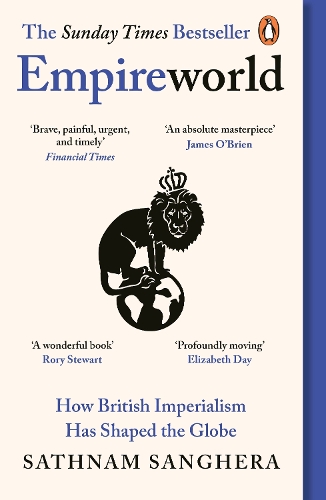 EmpireworldSathnam SangheraRecommended Retail Price: £10.99Price: £8.99The bestselling author of the award-winning Empireland delivers another powerful volume on the far-reaching consequences... See moreThe bestselling author of the award-winning Empireland delivers another powerful volume on the far-reaching consequences of British colonialism, this time exploring the UK's imperial legacy ... See more
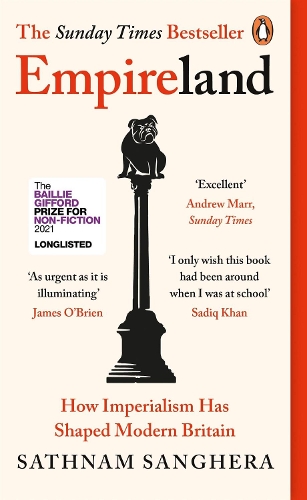 EmpirelandSathnam SangheraPrice: £10.99An urgent, incisive account of how the depredations of its imperial past dog Britain’s view of itself today, Empireland ... See moreAn urgent, incisive account of how the depredations of its imperial past dog Britain’s view of itself today, Empireland is provocative, meticulously researched writing of the highest order. See more

Sathnam Sanghera was born to Punjabi immigrant parents in Wolverhampton in 1976. He entered the education system unable to speak English but went on to graduate from Christ's College, Cambridge with a first class degree in English Language and Literature. He has been shortlisted for the Costa Book Awards twice, for his memoir The Boy With The Topknot and his novel Marriage Material. Empireland has been longlisted for the Baillie Gifford Prize for Non-Fiction, was named a Book of the Year at the National Book Awards of 2022, and inspired both the Channel 4 series Empire State of Mind and Sanghera's children's book about the British empire Stolen History. He lives in London.