


Reviews: After Sundown (7)
“A fine collection of 20 spine-tingling shivers!”
(Hardback)
If you're into binge-reading short stories and horror, then this is the perfect collection for you. Each story is delicately crafted to ensure top grades for the "jumping-at-the-slightest-sound" factor. There is some truly brilliant writing going on here. There are a few new names to add to my list of authors that I want to read more of. A fine collection of 20 spine-tingling shivers!
My thanks to the author, publisher, and NetGalley. This review was written voluntarily and is entirely my own, unbiased, opinion.
“Probably the best horror anthology of the year..”
(Hardback)
'After Sundown,' edited by Mark Morris, is a new horror anthology out on Flame Tree Press.
Specifically in the horror field, I've always been a big fan of anthologies. Over the years, I've discovered some of my favorite horror writers this way because they have a limited time to hook me and deliver and I've found if they can do that in this format, it's almost a sure thing in novels later on.
Of the 20 original horror stories included, 16 of them were commissioned from some of the top names in the horror genre. The cool thing about this anthology, which will hopefully be an annual non-themed horror anthology release, is 4 of those 20 were selected from 100's of stories sent to Flame Tree during a 2-week open submissions window.
What a great way to discover new talent and see how well they might be received!
Some of the short stories, as to be expected, are just slightly unpleasant 'what if' scenarios relating to post-apocalyptic situations, experimentation, or even sort of surreal pandemic settings. All of the stories are at least good.. but there are a few that I feel are exceptional.
I have to start with 'Wherever You Look' by Ramsey Campbell because he's just still such a master in the field. I can't even remember how old I was when I first discovered his work.. probably 15 or so.. and it was definitely in one of those old anthologies I was about to learn to love.
Campbell obviously loves to play with things that skirt the periphery of our minds. Those tricks our brains play on us when we sometimes think we get a glimpse of something out of the corner of our vision, only to turn and see nothing.. or things that are ever present, that we somehow manage to overlook until it's too late.
This story is no different in that regard and it's absolutely one I will carry forward with me. Even now the concept lingers at the back of my mind. I know the experience would be terrifying and love the slow, subtle approach he uses to torment both the character and the reader.
'Mine Seven' by Elana Gomel is a special story, as it takes place near the Arctic Circle and explores concepts of Chukchi folklore, an indigenous people who live within the Russian Federation. Leveraging shamanic themes and a more existential horror style, though the mythos itself is far different.. it carries an almost Lovecraftian feel in the tale's atmosphere. I loved this, as I don't feel we see nearly enough diversity in the industry as a rule, and in the US at least.. we so lack exposure to the eastern storytelling styles that readers often don't even know how to process the differences.
'That's the Spirit' by Sarah Lotz is another really disarming story. It's incredibly well delivered with such a delicate touch of foreshadowing it's actually difficult to see. While I thought I knew what was up, I was completely wrong. She took a classic theme and still managed to surprise me with its use.
'It Doesn't Feel Right' by Michael Marshall Smith is a fantastically creepy read. Smith writes with such an easy humor in the initial pages that I almost forgot that I was reading horror and so with the first glimpse of something really off.. I was so alarmed by it he had me thinking of some of my favorite classic horror films. I won't name them here, because I'd hate to ruin the experience for anyone.. but it was definitely chilling.
Though I'm hard pressed to pick just only one more, 'Alice's Rebellion' by John Langan must be it. I love stories born of Wonderland and it intrigues me that as dark as the original tale is, new perspectives are often even darker. This story is lovingly rendered in a style suitable to follow Lewis Carroll's, though it's less whimsical, it's just as wild. Yet, at the same time, one can't help but see the presentation of our modern world often in very literal, specific ways, throughout. It's a favorite, for certain.
If you like horror and anthologies at all.. do yourself a favor and pick this book up. It's actually probably the best collection I've read all year.. and there are plenty of gems inside. Plus, I'd love to see it get the support it needs to become that annual release they're hoping for.
(More reviews like this at Betwixt The Sheets.)
(I received this title as an ARC. All opinions are mine and freely given.)
“Strong and wide-ranging collection”
(Paperback)
I'm grateful to the publisher for an advance copy of After Sundown to consider for review.
I love a good collection of horror stories. There's something about the short form that, to me, makes it the ideal vehicle for horror: while there are many excellent full length horror novels, there are also many that - due to their length - can't sustain the necessary tension, or are vulnerable to the irritated reader's call for the characters to do the sensible thing, whatever that is. In shorter stories, we can be carried away, lost to the dreadful thing, whatever it is, before there's time for such alarms and second thoughts.
This is a good collection of horror stories. It has some authors I recognised and know to be renowned writers of such fiction, others I was less familiar with. There is a broad range of themes: creepy children, environmental horror, human irrationality or evil, folk horror, the classic Jamesian trope of a man of letters who is haunted by an object, stories of revenge from beyond the grave, strange abandoned (and spooky) settings, the plan weird - and more. Together the stories chill, and if there are authors here you haven't read before (it would be hard to have read them all) it's an excellent jumping off point to their various bodies of work.
Inevitably, I enjoyed some stories more than others: my favourite was perhaps Same Time Next Year by Angela Slatter which opens with Cindy sitting on a tomb in a country cemetery just after sunset. She can't remember quite how she got there, or where she belongs, but there is a suggestion of violence, of trauma, in what she does recall. Even that name isn't hers - it was given to her by a boy who treated her badly. If she stays where she is, something bad is going to happen, for sure. We hope she'll be alright. I found this a perfect gem of a story, comprising equally a mystery, rising tension about what was going to happen next, and empathy for the sad central character.
I also really enjoyed Swanskin by Alison Littlewood, a chilling take set in a remote coastal town, where the boozy, rollicking behaviour of the town's men turns out to have a direct link to their abuse of nature and of their womenfolk. But nature can have a way of redressing the balance. Set at some indeterminate time which could be anywhere in the past two hundred years, this one has the feeling of a classic.
Bokeh by Thana Niveau also really impressed. "Bokeh" is a Jananese word, used to describe the out of focus parts of an image - the smeared background, or dancing globes of light. In this story, Vera begins to experience it in real life. Perhaps she needs glasses? But what does that have to do with daughter Keeley's bloodthirsty fantasies about her toys?
The remaining stories are, though, all very strong and variety means that everyone will find something to appreciate (unless you don't like horror in which case, well no, this might not be for you).
Horror is, perhaps, though, relative. In Butterfly Island by CJ Tudor, we meet a group of protagonists who have already experienced a collapsing world due to disease, natural disaster and war. Still, the modern world provides them with enough support to live a debauched existence in and around a beach bar. You have thought they would hang on to what they had rather than run the risk of a boat trip to a deserted island... a good story to open the collection with, Butterfly Island shows that things can always, improbably, get worse.
What's the worst thing you can do to an author? In Research, Tim Lebbon seems to be saying it's to interrupt them when about to finish a novel. In fact his neighbours Sue and Alan have darker plans. This one is classic horror, showing the darkness that can lie behind suburban windows.
In contrast, That's the Spirit by Sarah Lotz is an almost comic tale of fraudulent psychics scratching a living from the gullible bereaved, Underneath the humour there's a grim theme - how far to go, what lines to cross, who to dupe? What does that do to you and what might the consequences be? Deceptively charming, this one has a real chill in its tail.
Horror can take many forms, from supernatural to natural disaster to smaller, more intimate tales of destruction and terror. Gave by Michael Bailey blends the latter two, being set in a future world where the population is, inexplicably, falling (having peaked at 17 billion or so). The impact of the deaths is counterpointed with one elderly man's desperation to donate blood, almost as though he's trying to push back the time of dying even as he like everyone watches the falling population numbers in real time. There's something weird about the focus on blood, blood groups, on lost kids and lost lives. Like the best horror this doesn't try to explain what is going on and leaves one to speculate.
Ramsey Campbell is of course one of the masters of the genre. In his Wherever You Look, we see another author suffer a dreadful fate. If, as in Research, interrupting the writing process must be one nightmare for an author, here is another - finding something in your stories that you don't remember putting there. Is Maurice Lavater being accused of plagiarism at the start of this tale? Or... something worse? I found the passage where he hunted through his writings, finding things he never recalled but which grew to make a ghastly kind of meta logic, truly chilling.
Elana Gomel's Mine Seven is another story with an environmental focus, taking us to the icy (if melting) wastes of Svalbard. Lena has, in a sense, come home to the land of her ancestors - although she's less enthusiastic than her partner Bill and would really prefer to sit in the library of the winter lodge and read than hare about the countryside dodging Polar bears and viewing the Northern Lights. Pity Bill didn't take her advice...
It Doesn't Feel Right by Michael Marshall Smith is a fraught story about a young couple having behavioural problems with their sometimes truculent, sometimes loving, five year-old son. Having been there myself (and yes, they grew up reasonably well adjusted) my stress levels rose quickly through this story, anticipating all the things that might go wrong - but I didn't guess the truly horrific twist that was coming.
Laura Purcell's Creeping Ivy is a very traditional form of ghost (or monster?) story, with the variation that we are I think cheering on the ghost/ monster. The end is not really a surprise but rather something to anticipate with relish. Purcell's writing is, as ever, spot on, creating a whole world in a few pages.
Last Rites For The Fourth World by Rick Cross returns to the environmental theme in what is a strange story, ranging across a number of locations where we see... well, strange things. Strange dead things. The horror is less a personal trial, a spooky location or ancient evil but a situational nightmare, a crisis we are all embroiled in but can't alter. A thing you can't run from or keep at bay with wards or garlic.
In We All Come Home by Simon Bestwick, Robert Lennox returns to Wardley New Hall - the site of a mysterious trauma in his childhood whose memory her has suppressed - in an attempt to find healing and to move on. But is it ever wise to go bavck?
The Importance of Oral Hygiene by Robert Shearman will really hit a nerve if you're a fear of dentists... a creepy Victorian-set story with themes of abuse - don't read just before your next appointment!
I've enjoyed Grady Hendrix's horror novels but hadn't read any of his short stories. Murder Board is a chilling piece about Caroline and her ageing rockstar husband David's dabbling with a Ouija board is simply perfect, tapping into the idea of a Faustian bargain: we know things will go wrong - this is a horror story - but Hendrix manages to keep the reader guessing almost till the end as to just what.
I'm glad it's not just me who thinks the whimsicality of Lewis Carroll's Alice only a hair's breadth away from truly unsettling horror. I'vc seen whole anthologies dedicated to that idea, but it remains something I'm deeply fascinated by and Alice's Rebellion by John Langana scratched that itch. Langana's story recognises that a ruler who calls for their opponent's head to be offed is really not a Nice Person and imagines a familiar figure in that role... who are the monstrous Tweedledum and Tweedledee of today?
The Mirror House by Jonathan Robbins Leon sees English literature professor Stephanie give up her independence and her career for her husband Edgar - but she's about to be disillusioned by him - and by the fancy house he bought, which seems to have its own secrets.
The Naughty Step by Stephen Volk is another story focussed on a child. It's also an insight into the stressful life of social worker Linda, called out when a young boy, Jared, is found in the house where his mother was murdered. He won't move from the "naughty step" on the stairs where his mum told him to go b efeore her death. So Linda prepares to spend the night...
A Hotel In Germany by Catriona Ward is a very different sort of story from most of the others here. Cara, whose brother and daughter are dead, seems to be a dogsbody for a woman described only as 'the movie star' who is on location in Germany. Selfish, demanding and petulant, the 'star' summons Cara at all hours of the night and we wonder why she doesn't just quit. The revelation of just how far Cara is required to go comes alongside an understanding of why, giving. real sense of horror (if if we never quite understand the connection between the two women).
Finally, I enjoy Paul Finch's gritty ghost stories set around abandoned mills, derelict yards and canals. Branch Line, the last story in this book, didn't disappoint, setting us up for a story which seeming to feature two innocent young boys getting into trouble (for a certain value of "innocent": much of the motivation at the start is a cache of prime dirty mags, this is set in the 70s) but which manages to pivot to something much darker and to a rather nasty twist...
Overall, this is a strong collection which will have you looking uneasily at midnight shadows, bolting your doors and avoiding lonely, derelict places after dark. Unless, of course, you're actually a monster already...
“A treat of a read!”
(Paperback)
This is an excellent collection of short stories. All the more impressive being a mix of prolific authors and some unknown, as of yet!
There’s such a variety of horror and I enjoyed all. It’s an easy read, but, with some genuinely scary and thought provoking stories and it’s perfect for this time of the year.
Congratulations to Mark Morris who edited this treat of a read.
“a mixed bag: some are excellent”
(Hardback)
After Sundown is a collection of twenty horror short stories edited by Mark Morris. The contributors are published authors.
BUTTERFLY ISLAND (C.J.Tudor) is set in a post-viral world and features flesh-eating butterflies, a psychotic maniac, mines and some greedy, gun-happy opportunists. 4/5
RESEARCH (Tim Lebbon) an author ends up inside a plot that could easily be his own. 5/5
SWANSKIN (Alison Littlewood) a fishing town with wintering swans, beautiful women and cruel men. 4/5
THAT’S THE SPIRIT (Sarah Lotz) a fraud psychic with an elderly sidekick and electronic aids begins to wonder about the “messages: his assistant denies sending. 5/5
GAVE (Michael Bailey) a regular donor does what he can for a diminishing population 2.5/5
WHEREVER YOU LOOK (Ramsey Campbell) an author of supernatural thrillers finds himself being haunted by a character. 5/5
SAME TIME NEXT YEAR (Angela Slatter) the one light of the year when ghostly Cindy has some weight is not a good night to hang around the cemetery. 5/5
MINE SEVEN (Elana Gomel) when Lena and Bill go on an Arctic winter vacation, the melting ice unleashes a very old curse. 5/5
IT DOESN’T FEEL RIGHT (Michael Marshall Smith) a father discovers that his is not the only child in the neighbourhood whose socks initiate a “doesn’t feel right” tantrum. 5/5
CREEPING IVY (Laura Purcell) a nineteenth Century garden lover’s plants take revenge for her murder. 4/5
LAST RITES FOR THE FOURTH WORLD (Rick Cross) mythical monsters turn up dead in strange places. 3/5
WE ALL COME HOME (Simon Bestwick) a man returns to the site of a childhood trauma to face a repressed memory. 4/5
THE IMPORTANCE OF ORAL HYGIENE (Robert Shearman) a woman writes a letter of warning to her husband’s lover. 5/5
BOKEH (Thana Niveau) Vera’s daughter sees fairies, but no the Tinkerbelle kind. 4/5
MURDER BOARD (Grady Hendrix) a Ouija board session sets off a string of deadly events. 5/5
ALICE’S REBELLION (John Langan) post-Wonderland, Alice finds her battles not yet over. 4/5
THE MIRROR HOUSE (Jonathan Robbins Leon) a wife discovers an alternate reality in the pantry. 4/5
THE NAUGHTY STEP (Stephen Volk) a social worker comes to care for a little boy at a murder scene. 5/5
A HOTEL IN GERMANY (Catriona Ward) a movie star and her personal vampire(?) on location in Germany. 3/5
BRANCH LINE (Paul Finch) at almost sixty, Richard Gates is questioned about the disappearance, over forty years earlier, of his classmate, Brian O’Rourke in the abandoned Branch Line. 4/5
This collection is a mixed bag: some are excellent, and five of the stories, Research, That’s The Spirit, Wherever You Look, It Doesn’t Feel Right, and Murder Board, are quite outstanding.
This unbiased review is from an uncorrected proof copy provided by NetGalley and Flame Tree Press.
Page of 2
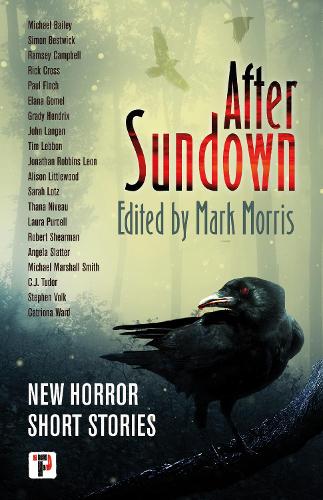
After Sundown
Fiction & Poetry, Modern & Contemporary Fiction
Mark Morris (editor)
Paperback Published on: 20/10/2020
Price: £9.95