


Reviews: Barbarossa (2)
“Eye-opening”
(Paperback)
An excellent account of the horror of the war on the eastern front. Not one for the faint-hearted. Probably as good as has been written on this subject.
“Hard-hitting and erudite”
(Paperback)
Thanks to Penguin for sending me a proof copy in exchange for an honest review, which you can find below.
The struggle between Nazi Germany and the Soviet Union played a crucial role in the Second World War, and yet it can be overlooked by the Western World. Events such as D-Day and the Battle of Britain are far more familiar than Operation Barbarossa, the name given to the German invasion of the Soviet Union. This book provides an excellent overview of what Dimbleby argues was the fatal error made by Hitler, making full use of Russian archival sources to construct a compelling and timely narrative.
All wars are necessarily brutal and horrific, but the conflict on the Eastern Front was without doubt one of the most savage in history. The invading German forces, indoctrinated in Nazi propaganda stating that the Slavic peoples were effectively subhuman, committed countless atrocities on both prisoners of war and civilians, while also carrying out the unspeakable barbarity of the Holocaust. Spurred on by these acts of cruelty, the Red Army sought revenge in turn, as well as showing little mercy to any of its own soldiers who attempted to flee from the fighting. Dimbleby captures the horrors of industrialised warfare on a mass scale, ensuring that the staggering statistics are always visualised and the human costs of war are fully understood. The overarching narrative of an overconfident nation believing its own propaganda and expecting an easy victory then being frustrated by its own logistical difficulties as well as often suicidally brave resistance is also reminiscent of Russia's current invasion of Ukraine. This serves as a powerful reminder that the tragic folly of wars inflicted by megalomaniac dictators on innocent populations is an eternal threat, even in the heart of supposedly civilised Europe.
While the author captures the military struggle of Barbarossa and the suffering of the troops and civilians involved, he also impressively links this struggle to its wider context. The role of other powers, principally Britain and the United States, are covered in great detail. Additionally, Dimbleby captures both the historical precedents for Hitler's gamble, dating back to the Treaty of Versailles in 1919, as well as the consequences on the post-war shaping of Europe. He argues that by leading to the Soviet Union inheriting a sphere of influence in Eastern Europe, Operation Barbarossa remains one of the most significant events not just in the course of the Second World War but in the entire history of the 20th century.
This book provides an excellent overview of an enormously important event, detailing the political and military struggles as well as the social tragedy involved. I would thoroughly recommend it to anyone interested in military history, but the readable writing style and emotional human stories contained within elevate this to the level of superior history enjoyable by anyone with a yearning to learn about one of the most far-reaching and impactful decisions of the past century.
Page of 1
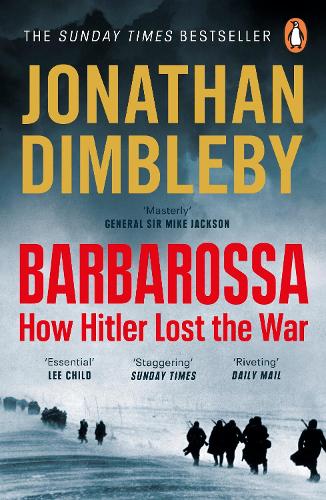
Barbarossa: How Hitler Lost the War
Non-Fiction, History & Politics, Military History, The Second World War
Jonathan Dimbleby (author)
Paperback Published on: 12/05/2022
Price: £12.99