


Reviews: Blank Canvas (16)
“An impressively mature novel from an author with a bright future”
(Paperback)
The debut novel from a Norfolk born based writer, and 2025 English language graduate from the Edinburgh University – this novel written as part of her participation in 2024-24 WriteNow, Penguin Random House’s flagship mentorship scheme for emerging talent.
The set up of the novel is simple, our first party narrator - an English girl Charlotte – is studying at a small New England liberal arts campus and decides, on something of an impulse, to start her final year by sharing that her father back in England died over the Summer Break – starting with telling Katarina (a girl who she – claims she - finds almost magnetically physically unattractive but nevertheless charismatic).
The problem is that her father – who loves in their small family terrace in Staffordshire – is very much alive if very distant (initially we think by way of very different cultural circles – but we quickly realise due to a more serious/longstanding breach, we also realise quickly that Charlotte’s mother died some time ago); and secondly that Katarina immediately latches on to the news and seems to make Charlotte some form of project (art projects feature throughout the novel).
And the repercussion of both the lie and the rapidly intense relationship then play out through the novel which takes place over three main phases: the initial set up and Charlotte’s last year at college with Katarina and her circle of friends; a working Summer holiday that she takes to Italy with Katarina and two of Katarina’s gay friends (themselves in a relationship) – one which finally brings her deception to a head; the aftermath back at college.
Charlotte – a non-believer – had catholic parents and still has buried sensibilities (or at least a sense of guilt) but herself a deliberately neutral, almost para-ethical take on life – almost the first we hear of her is her statement that: “I had no standards to live up to, either. I had never been particularly honest. Other people were good and kind – the rest were predestined for mediocrity, or cruelty. It wasn’t my fault that I fell, through the random act of my birth, into the second category. If I ever woke up with an ungodly dread – that I could change it all now, turn around, and confess – I ignored it. I had never been good, and there was no point in trying now.” and later “Because I was an idiot, I believed that if I could cut goodness out – laughter, kindness, generosity – I might be protected from negativity, simply by becoming an emotionless eunuch. This was unsuccessful, obviously. I left the exhibition drained, and drew my blinds the minute I got back, keeping them closed”.
Charlotte, to Katarina’s frustration, is the titular blank canvas: “My personality could be characterized by a distinct lack – of almost everything. Lying was one of the only things I did for myself, the only time I felt active, a real person, and I was good at it. But it was just another absence, this inability to be honest.”
In the afterword, Murray quotes novelists Garth Greenwell, Brandon Taylor and K Patrick as inspirations – for me I was reminded perhaps more of Elif Batuman (with perhaps less goofy humour) and Ledia Xhoga (and her recently Booker longlisted “Misinterpretation) in an outsider’s portrayal of America and its collage and art scenes respectively. I must say that it is very refreshing to read an American campus novel written by an English writer as it removes the unfulfilled need for cultural translation that I require in many campus novels (2025 Booker judge Kiley’s Reid’s “Come and Get It” just one example).
But whereas Brandon Taylor’s Booker shortlisted “Real Life” campus novel featured a biochemistry student (and was interesting as a result) the art students here with their desultory attempts at any form of hard work and conceptual art projects in which serious art and satire seem almost interchangeable were not to my liking at all – and I must admit after a really interesting initial set up and the intrigue of Charlotte’s voice I found myself really struggling – her three holiday companions in Italy were far from my ideal novel companions.
The novel for me though took off when her father (who for some time was only really a nagging presence for Charlotte knowing she has lied – and that for the novel felt to have a Chekhov’s Gun style inevitability of unravelling) enters the narrative – as suddenly we are privy both to some hard revelations about Charlotte’s past (and the reason for her blankness and for her strained relationships with her father) but then a pathos which resists easy resolutions – making this an impressively mature novel from an author with a bright future ahead of her.
This reviewer received a free of charge product for review.
“An incisive debut on honesty, guilt and reinvention”
(Paperback)
When Charlotte tells her fellow art student Katarina that her dad died over summer break, she realises how easy it is to deliver these fantasies to her sympathetic classmates and reinvent herself, a continent away from Lichfield and her very much alive father. But when Charlotte and Katarina end up romantically involved, it's only a matter of time before the truth is revealed. Grace Murray adeptly captures the dread of waiting for a lie to be found out, and the uncertainty of what is going to happen next.
Charlotte is a frustrating character. Blank Canvas is the perfect title to capture her avoidance, her emotional repression. She's on the periphery, cynically observing her fellow art students' exaggerated traits whilst not displaying much of a personality herself. You're often not just willing her to be honest, you're willing her to offer anything of substance at all. This isn't a criticism - I love problematic characters who don't behave the way people "should". The novel also delves into her childhood and why she is so closed off, which was heartbreaking at times.
This is a strong debut and a great character-driven story. I appreciated that a novel about such a complicated character didn't end with everything being magically resolved. It's a realistic coming of age story that captures the awkwardness of trying to make meaningful connections at university, and coming to terms with your past in order to make the best of your future.
“Great literary novel”
(Paperback)
Blank Canvas is a novel that’s far less interested in exposing a lie than in examining why someone might need it in the first place.
Charlotte, an English art student spending a year at a small American college, invents the death of her father almost casually - and then quietly builds an entire version of herself around that absence. What follows isn’t a thriller about being found out, but a close, psychologically focused study of loneliness, self-erasure, and the strange intimacy that grief (real or performed) can create.
Grace Murray’s control of voice is impressive. The novel stays tightly lodged inside Charlotte’s head, capturing her vanity, insecurity, and moral evasions with sharpness and restraint. The prose is often darkly funny, sometimes deliberately uncomfortable, and very attuned to the self-conscious intensity of early adulthood - especially within a campus environment where everyone is experimenting with who they might become. Charlotte’s lie doesn’t make her exceptional so much as it makes her legible, and that’s where the book’s real interest lies.
I particularly appreciated how the novel treats identity as something fluid and imitative. Charlotte’s relationships - especially her romantic one - blur the line between desire and self-disappearance, and the book is very good on how longing, shame, and admiration can collapse into performance. There’s a strong sense that Charlotte doesn’t yet know what she wants, only what seems to make her more acceptable.
That said, while I admired the book’s psychological precision, I struggled to fully connect with it on an emotional level. Charlotte’s detachment feels intentional and thoughtfully rendered, but it kept me at a certain distance as a reader. Midway through the novel, a shift in setting and energy briefly opens the story up, and I found myself wishing that looseness and expansiveness had arrived earlier.
Overall, this is a smart, controlled, and unsettling debut that knows exactly what it’s doing. I didn’t love it, but I respected it deeply - and I’ll definitely be curious to see what Grace Murray writes next.
This reviewer received a free of charge product for review.
“Book 321 of 2025”
(Paperback)
Okay, so I really didn’t like Charlotte, how could anyone find someone who lies like that a nice person?! I felt so sorry for Katharina and having a relationship built on lies.Yes she was grieving and she had a troubled relationship with her dad, haven’t we all ? but that was hardly and excuse for her behaviour, I did however enjoy seeing her character development.
This reviewer received a free of charge product for review.
“A good debut!”
(Paperback)
Blank Canvas sets the scene with a to the point Brit, Charlotte, at art school in America, trying to navigate life. Touching on themes of loneliness, sexuality, religion and grief this is a good starting point for anyone wanting to branch into the world of contemporary fiction.
This starts off so strong but I felt it got a little lost in the middle making the ending seem a bit rushed... but overall a good debut. I will read whatever Grace Murray writes next.
Page of 4
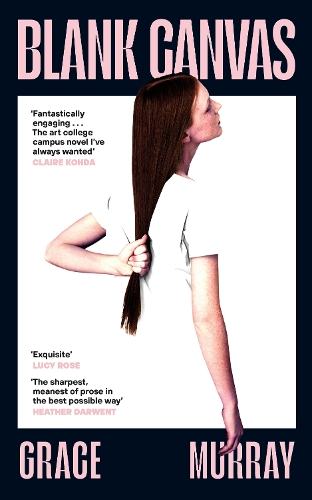
Blank Canvas
Fiction & Poetry, Modern & Contemporary Fiction
Grace Murray (author)
Paperback Published on: 15/01/2026
Price: £14.99