


Reviews: Delphi (7)
“Binged in under 24 hrs”
(Hardback)
I binged this book in under 24hrs. Our protagonist is a classics lecturer, wife and mother. Using different concepts of prophecy and classics references as narrative tools, we follow her into and out of the Covid-19 pandemic. I have to say, all other books I've read which even touch on the pandemic have given me the ick, but not this one. Delphi is full of wit and laugh out loud charm whist also covering the toughest part of many of our lives with realism and heart wrenching relatability. Having been looking after a group of teenagers throughout the pandemic and beyond, the reference to the song 'Dum Ways to Die' was a bit of a matrix moment. This book, driven by themes of coincidence vs prophecy, prediction and foretelling, was somehow relating much of my own experience of the pandemic back to me, even down to the finest detail. I would highly recommend it.
TW pandemic, self injury, suicide
“Struck a chord with me”
(Hardback)
I picked up Delphi thinking it was going to be one of the popular Greek myth feminist retelling stories that I like, but found a thoughtful novel about the coronavirus pandemic instead, lightly sprinkled with classical references. I was definitely not disappointed.
Delphi is a surprisingly enjoyable read that precisely captures the feeling of being trapped on an endless treadmill and wanting to break free and just make a change. It really struck a chord with this forty-something woman reader.
Thanks to the author, publisher and NetGalley for providing a review copy in exchange for honest feedback.
“Obsessive soothsaying”
(Hardback)
COVID-19 hits London. A classics academic, when the family trip to Delphi is cancelled, becomes obsessed with learning the future. As the pandemic spreads, her husband Jason steadily ignores her and drinks more, while their only child grapples with severe asthma and deteriorating mental health.
I have never read anything quite like this before and I loved it. The short chapters punctuated with sharp observations on human behavior are reminiscent of Jenny Offill's Dept. of Speculation. The writing is pithy and voluptuous in turn (Pollard is a poet and this is her debut novel). The many references to Greek mythology, to writers (both modern and in antiquity) and to modern philosophy are fascinating.
In the future, this book will be read as a chronicle of how a middle-class family coped--and did not cope--with lockdown. Each chapter is titled after a different form of prophesy, from reading bloody entrails to the contemporary scanning of social media. It's an exploration of how we humans try to deal with uncertainty, with loss, with change. It's a quiet gem of a book and I urge you to read it.
“Highly recommended”
(Hardback)
There's so much to say about this book. It's the description of a time of our life but also of how the future is unpredictable and losing focus on the present can bring disaster.
Claire is a fascinating character, the author did an excellent job in describing the age of Covid.
Thought provoking, entertaining.
Highly recommended.
Many thanks to the publisher and Netgalley for this ARC, all opinions are mine
“A very distinctive book which is both easy to read and through provoking.”
(Hardback)
Clare Pollard is an editor, journalist and teacher as well as an author of poems (for which she is best known), plays, non-fiction books and poetry translations (including of Ovid) and a frequent poetry prize judge. This is her debut novel.
When I saw the title of the novel I thought it was in the recent genre of feminist novelistic retellings/interpretations of Greek myths, but while there is a very strong element of Greek and Roman mythology running through the novel it also has in my view in the immediacy of its writing strong elements of Olivia Laing’s “Crudo” or (perhaps even more pertinently) Jenny Offill’s “Weather”, and in its exploration of political events as they develop there are elements of Ali Smith’s Seasonal Quartet.
It will I think be seen as one of the key examples of the relatively nascent genre of books exploring COVID not indirectly via dystopia (of which there are many excellent examples such as Hanya Yanagihara, Sequoia Nagamatsu, Emily St John Mandel, Sarah Hall ) but by direct and relatable experience (perhaps only Sarah Moss with “The Fell” has attempted this so far in literary fiction).
But over all of that, and returning to the book’s title, this is fundamentally a book which explores the way in which humans over the years have tried to reduce the feeling of chaos and entropy in their lives and societies by the arts of prophecy and prediction in all their forms.
The narrator is a 45 year old part time Classics lecturer at a London University, part time translator of novels (from German), married (to Jason – an ex-DJ who works for a Charity) and with a ten year old son Xander (who suffers from various allergies and skin conditions).
And it is set over the 2020-early 2021 period both with all of the developments of COVID in the UK (for example the initial threat of the disease, the sudden import from Italy, hoarding, masks, leaving groceries, queues in supermarket carparks, the lockdowns and Tiers, the chaos that was Christmas 2020); the common personal impacts (for example juggling WFH with two parents, Zoom-fatigue, public school home-schooling in all its disasters, excessive drinking, binge watching TV, COVID privilege guilt – the need to apologise for having a garden) and with everything playing out in public (for example the failures and scandals of PPE and Test and Trace, the murder of Sarah Everard and the failures of the Met Police, BLM, Trump in his various phases, climate change, the surprisingly UK successful vaccination programme)
The book has a distinctive structure – some 60 or so chapters, typically of say 2-3 pages but varying in length from a few lines to 5-10 pages, almost all of the chapters featuring the name of a type of prophecy. So a few examples – chosen purely at random: Rhapsodomancy: Prophecy by Poetry; Stichomancy: Prophecy by Lines Chosen at Random; Ovomancy: Prophecy by Eggs; Chresmomancy: Prophecy by the Ravings of a Madman and so on.
And the chapters – told in the present tense in an accessible but intelligent prose mix all of the above with the narrator’s developing family and interior life and with her musings on the different forms of prophecy. The later are sometimes linked to current events (Ovomancy captures grocery hoarding, Chresmomancy the shortest chapter just says “Trump is still demanding recounts, so that’s a bad sign”), often to the narrator’s life but there are two other distinct elements – her Classics inspired musings on the beliefs of the ancients (the role of the Delphi prophetess is as you would expect central here) and her own lockdown dabblings in Tarot, Psychics and i-Ching.
And just to add an additional element – the narrator draws on her translation background to discuss various concepts captured in German compound words.
The overall effect is a very distinctive book which is both easy to read and through provoking.
I probably had two main criticisms of the book both of which I think were linked to the desire to make the link to mythology.
The first was that for a book about prophecy there was no coverage of either the role of prophecy in the foundation and continuing practice of monotheistic religions (the focus here all on polytheistic religions of the Greeks and Romans and modern superstitions), or of the way in which scientfic interpretation combined with mathematical modelling has taken over most of what was for millennia thought only to be accessible by some form of prophecy. As someone involved in a church where prophecy is practiced and who belongs to a profession dedicated to modelling of future uncertainty this meant the book felt diminished. And for a book that covers climate change and is entirely centred COVID it seemed odd to exclude the role of mathematical modelling combined with climatology and epidemiology in our understanding of both issues. But I think the author was more interested in prophecies which built on methods accessed by the ancients.
And secondly for a book light on plot (no bad thing at all) what plot there was seemed slightly melodramatic to me – particularly the double drama at the book’s ending, although I think this was an attempt to bring in some mythological dramatic themes.
Page of 2
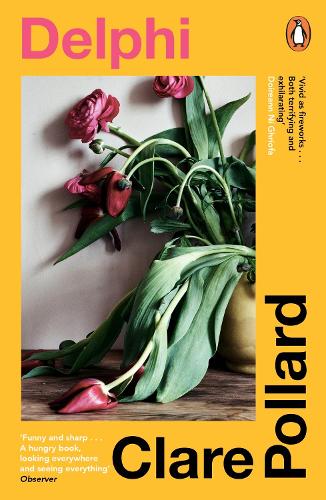
Delphi
Fiction & Poetry, Modern & Contemporary Fiction
Clare Pollard (author)
Paperback Published on: 20/04/2023
Price: £9.99