


Reviews: Fall (8)
“A moving, beautifully written novel”
(Paperback)
West Camel’s second novel, ‘Fall’, is a gripping tale set in London in the 1970s and the present day.
Twins Aaron and Clive have been estranged for forty years, following an event that sparked tragic consequences. Their paths suddenly cross again – as does the one with Annette and Christine, another set of twins entangled in those incidents of long ago. New light is thus cast on what happened, and on the perceptions, anxieties, prejudices and memory of family members, friends and neighbours.
The book’s fast pace, suspense and twists keep you turning the pages, while the unfolding of complex characters and relationships draws you in. The protagonists are so credibly and three-dimensionally drawn that the human flaws of some of them (saying more would risk a spoiler) elicit both judgment and compassion. Deftly achieved shifts in characters’ point of view, punctuated by the omniscient narrator’s thought-provoking remarks, are integral to the book’s emotional complexity. Profound themes, including gender discrimination and racism, emerge naturally, believable and hard-hitting in the accumulation of actions and outcomes. West Camel’s love of language shines through his assured prose, with subtly measured variations in both tempo and intensity. A novel that leaves you wanting to read more by its superb writer.
My thanks to Orenda Books for the proof copy of ‘Fall’.
“:)”
(Paperback)
it's good
“A stylish, immersive and beautifully-written must read!”
(Paperback)
Fall spans a forty five years-long moment in time, pivoting on one summer … one night that summer … one moment of that night. At the heart of the story are two sets of identical twins; Aaron and Clive, and Annette and Christine … one sibling pair white, the other black. The twins first meet during the stifling summer of 1976, the heat diffusing the prose with a languid haze. It was easy to fall under the spell of the text’s immersive rhythm, although I was often shaken out of it by bursts of prose that sharpened the passage, punching through the almost dreamlike fluidity of the story; at times it was a sentence so sublimely perfect I found myself re-reading it several times just to enjoy it again; at other times it was the cold, hard shock of the racist views of that time. Beneath it all flows a foreboding acceptance that something insurmountable and dreadful has happened … or will happen - depending on whether you’re more beholden by the present day storyline or the ‘76 storyline. Both era narratives are utterly absorbing, woven together in such a way that they somehow illuminate each other, and hide each other’s secrets … they spiral together like the twisted helix of DNA, or the thirty-storey staircase rising up through the heart of Marlowe Tower, carrying you not-that-gently towards the moment when they drop the breathtaking truth in your lap.
My first, and enduring, impression was how quietly impactful the author’s writing style is. He tells a complex story with profound intimacy, wrapped within a simple plot. The prose is both lyrical and disembodied, creating a forlorn, haunting atmosphere that pulses with life; I can only explain its densely evocative rendering as an insistent, baited beckoning into the lives of its vividly-crafted characters.
There are no speech marks in this conversation-rich novel, and yet the style and formatting left me with absolutely no uncertainty over who was speaking to whom. I know this won’t be to everyone’s taste, but over the last year I’ve read some truly unforgettable novels where the author also adopts this technique (Still Life by Sarah Winman, My Brother by Karin Smirnoff) and I have to say I love it … it’s moody, intelligent, and distinctive, and skilfully forges a closer reader-character dynamic.
For the most part, Fall is written in the third person, but from time to time the narrative shifts, and it’s as if the reader is hand-in-hand with the author, flying through the scenes within the Tower; unseen but all-seeing. In these passages, the author refers to ‘we’ - him and me - creating the impression I’m somehow haunting the story and seeing it all first hand. It was one of many literary touches I hugely enjoyed.
At its heart, Fall is a sentient, percipient depiction of humanity, exploring and examining the bonds and tensions between families, siblings, friends, and neighbours. It manages to be both charming and conflicting, with the thought-provoking perspectives of a truly engaging and eclectic cast of characters. The author’s enticing storytelling and intelligent prose is emotionally engaging, stylistically expressive, and has totally, utterly hooked me. I’m already looking forward to reading more by West Camel.
“Beautiful and evocative”
(Paperback)
Fall is set mainly on the fictitious Deptford Strand Estate in London. Designed by idealistic architect Zoë Goldsworthy in the 60s to permit - or require - a 'new way of living', by 2021 it's fallen on hard times and is being reworked, the Marlowe Tower in particular into premium, exclusive apartments.
The redevelopment has split the Goldsworthy family. Zoë's twin sons twins Clive and Aaron are intimately connected with the project, Clive as head of the development company, Aaron, a resident (the only resident) of Marlowe Tower, bitterly opposed to change and - when the book opens - holding up the project. Whether this is out of respect for his mother, spite at Clive or simply because he doesn't want to move out isn't clear.
The antipathy between the two men goes back more than forty years, to the scorching summer of 1976, when the estate sizzled and anger rose among the (white) residents because of the arrival of two young Black women, also twins. Not that anybody on the Deptford Strand was 'racialist', oh no - they just didn't like outsiders...
In the quartet of Annette, Christine, Aaron and Clive, West creates a complex, simmering group among whom stresses arising from racial discrimination, coming-of-age, and the intricacies of twindom arc like lightning at the end of an overheated day. The double timeline particularly brings this out as Camel is able to examine the attitudes of the 70s from the point of view of the present day, casting additional light both where behaviour was unthinking (the language of the police, the prejudices of the estate residents) or where it was analysed and judged at the time.
Race isn't the only prejudice visible here. Once the estate was complete, Zoë moved her two boys from leafy Blackheath into a flat in the 24th floor of Marlowe Tower (where, four decades on, Aaron still lives). Outwardly an egalitarian gesture - Zoë argues that she should be willing to live anywhere that she designed - there does also seem an element of patronage and even control as, over subsequent years, she seems to see herself as the leading figure on the estate. And despite living alongside the working class residents, Zoë still sends her boys to distant schools rather than the one she designed, and mixes mainly with her own middle-class friends (who make visits akin to anthropological field trips).
One senses that the dislocation of that move, at the age of ten, still rankles with the boys, despite their outward devotion to their mother. As the events of the story unfold, they have just reached eighteen and are beginning to separate from one another, a painful process (though one Camel depicts very subtly) made more so by some shocking discoveries and twists in this story. In some ways the wounds of that summer will never heal, with Aaron and Clive still estranged even before the redevelopment is proposed - and their relationship with Annette and Christine is part of that breach. Delicately exploring issues of intention, (mis)communication and the search for redemption, this is a fascinating study. There are some dark themes and incidents but none of them are gratuitous and West uses the eccentricity of Zoë's architectural practice to lighten the mood when needed. Apparently seeing the place as a playground for her kids as much as a place for people to live, she designed it with a full complement of hidden doors and secret corridors, allowing access (for those who know) via shortcuts to most of the estate. A fun idea - but again one that seems to declare a sense of ownership, a right to dictate who goes where and how.
Fall is, like West Camel's Attend (shortlisted for several major awards) something of a study in secrets, the private routes and spaces of the estate echoing concealed corners and bits of private history in the lives of the four protagonists. As the estate is torn down and reshaped, the hidden will inevitably be brought to light - as, it seems, will the true events of 1976. Will that be a traumatic revealing, with dust and rubble everywhere? Or will letting sunlight into those unlit places clean and heal?
Never less than grabbily readable, Fall is an exploration of the recent past and our relationship with it. It's a book I'd strongly recommend.
“Immersive, beautiful, and haunting”
(Paperback)
West Camel’s Fall is a beautifully written story of family, divided loyalties and what happens when ghosts come back to haunt you. Reading it is like watching a tight flower bud unfurl one petal at a time. Fascinating, rather beautiful in its natural process; leaving you wanting to see the whole flower but not wanting to rush it because the process is itself a thing of beauty and so immersive.
Fall centres on an estate in Deptford. Designed by architect Zoë Goldsworthy to be the ultimate in communal living, she believed in it so much she moved her family there after it was built. David Ross’ architectural drawings give a sense of what Zoe wanted to achieve – planned building of different heights where everyone could live, shop and socialise along the banks of the Thames. It was a democratic vision from an architect of single minded resolve; Zoe was the first woman to design such an ambitious estate and it cost her dearly.
Fall has a dual timeline narrative. It takes place in 1976 just after the estate was built and in the present day, when the estate lies derelict and developers are eyeing it up with a view to creating luxury flats on a demolished site.
Central to the tale are Clive and Aaron. They are twins but have not spoken to each other for 40 years; the events of one summer’s night stand between them. Now Aaron and Clive are on opposite sides of this argument. Clive has become a developer; Aaron is the last resident, holding out against demolition.
At least he was the last resident. Now two others have moved back in. Not seen for years, Christine and Annette have returned to the estate which eschewed them all those years ago. In Fall, West Camel tackles big themes with a story of tragedy, betrayal and a lifetime of regrets.
There’s stillness and poetry to his writing that has a resonating impact. Picturing the boys looking down at their mother from their tower block, they see ‘her white linen trousers a sail crossing a grey concrete sea’.
Zoë is a woman in a man’s world. The choices she has made to achieve her success is something we discover as the book progresses. What is clear almost from the beginning though, is how the residents of this estate view their first black neighbours, and it isn’t pretty. Camel provides beautifully observed portraits of Aaron and Clive – showing their affinity; the way they finish each other’s sentences and how their thought processes seem interlinked, with one twin dominant, but the other never far behind.
Annette and Christine are also twins. We know them less well because they are outsiders and destined to remain so for as long as they live on the estate. They are joyful though. It is they who bring life and song to Deptford Strand and that makes the betrayal they face so much harder to bear.
Fall is a story of families; of being a woman in a man’s world and of the choices we make and the regrets that we have to live with as a result. There is sacrifice, and prejudice; bad decisions and subsequent regrets in this beautiful, immersive story set against the grey concrete blocks of Deptford Strand. Idealism vies with reality as we see how Zoe’s brutalist architectural vision becomes a trap for those who live there; watching as it slowly crumbles into decay.
Immersive, beautiful, and haunting, Fall is a novel that will bear re-reading over the years. Each phrase is so well-judged; each character has their own place in a story that transcends its plot and the clarity and distinction of the writing is a joy to savour. I adored it.
Page of 2
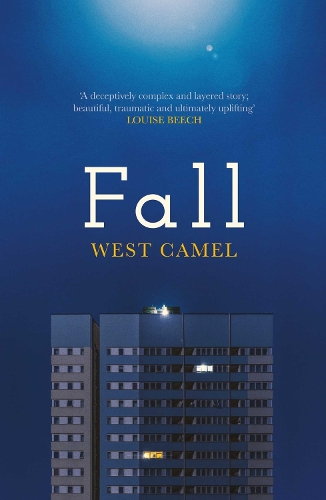
Fall
Fiction & Poetry, Modern & Contemporary Fiction
West Camel (author)
Paperback Published on: 09/12/2021
Price: £8.99