


Reviews: Gliff (19)
“Latest novel from the Seasonal Quartet Author”
(Hardback)
Ali Smith has become I would say something of a literary national treasure with "How To Be Both" and the Seasonal Quartet.
This is her latest novel and has many tropes that will be familiar to those who are like me fans of her writing:
The copious use of wordplay – homonyms, variations on a word, words with multiple meanings (and even here words with letters that start to disappear). Most noticeably and while the book’s blurb tells us correctly that “Gliff” is a “Scottish/northern word for a shock, a fright, a transient moment, a glance or sudden glimpse” – an entire chapter of the book reveals a wide range of alternative meanings with a later chapter then using an Urban Dictionary definition of “a substitute word for any word” (which I think may come from its apparent use in vocabulary aptitude tests in place of “____”)
An innovative publication approach. This time we are told that “Gliff” contains a hidden story which will only emerge in “Glyph”(a signifying mark – as in ‘hieroglyph’) a novel to be published in 2025 – with the two novels said to belong to each other (that idea of what belonging or ownership means being one of the very things this novel explores – in particular in the concept of human/animal relations)
The trademark slightly fey young child – here the narrator Bri(ar)’s younger sister Rose but also Briar themselves.
Literary and artistic references – I have spoken in the past about Smith’s work being something of a literary/art palimpsest (something Smith has included in previous works such as “How to Be Both”). Here literary references include most noticeable Aldous Huxley’s “Brave New World” (although here the text Brave New World is literally erased in the text rather than covered over), Max Frisch’s novella “Man in the Holocene”, the horse (and horse and lion) paintings of the 18th century painter George Stubbs and the fairy tale Briar Rose as well as apparent references to legends of fairies.
Political themes – typically written from a liberal/left wing, green viewpoint. Here Smith rails (perhaps that is an exaggeration given the lightness of her writing) against: smart phones (in what is in many respect a near and sometimes far future dystopian novel - the educators worn by other children seem chillingly little different in function or potential risk and impact from today’s smart watches); exploitative capitalism in both the service industries and in factories; environmental degradation (the most dangerous factories are based around extracting batteries from devices); the vacuum at the heart of rampant and performative consumerism – the real well-off in the society are so inert in their luxury as to be little distinguishable from still-life; industrial-agriculture and much more.
In terms of brief plot the book is set in, as I have said a near-future, country which to me seems a lot like England/Scotland. It opens with Bri (who when asked if they are male or female – and this in a society obsessed with measurement and recording and putting people in boxes, says “yes”) and Rose and their mother’s partner Leif leaving their mother in a luxury hotel where she is surreptitiously covering the work of her ill sister.
But when they return and find their home outlined with red paint (a marking which seems to convey some form of a pariah status of people who are “unverified” Uvs – for either their speaking of taboos or their unwillingness to participate in the digitised surveillance society which Bri’s Mum – a believer in reading and learning – resists) they flee. Shortly after their camper van is also outlined in red and Leif leaves them in a deserted safe house while he attempts to get their mother and avoid being placed in some form of adult retraining centre.
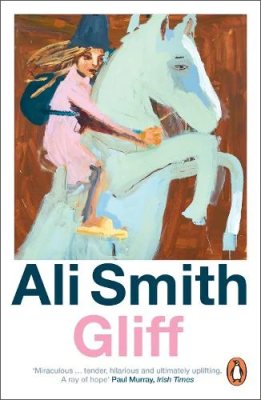
From there they eventually befriend a set of fellow outcasts living in an old school – St Saccobanda’s Sixth Form college (later a passage tells a tale of a horse headed daughter called Saccobanda) but more importantly before that they buy/rescue/steal an abattoir bound horse – a grey gelding (from his size) pony that Rose calls Gliff (although whether you can name a horse is a subject of some discussion - although as an aside the correct answer “Yes, normally a formal registered and informal stable name, but never change the informal name as it is really bad luck” is not given).
The story is effectively told by Bri some years later. Somehow they have gone inside society with an assumed identity and are working as a supervisor in a retraining factory, but an encounter with one of the workers (who claims to have known her sister in an organisation which for me seemed to have a potential link via the Campion flower to Bri’s mother) brings back the past.
Now I have to say that any book with a grey gelding pony and its centre (and its inside cover) is by default worth five stars already but I think the book works for the non-horse lover (although it may be a book which makes you want to shut the book and at least spend some time with a horse, and if so do not resist the temptation) – but so is any book written by Ali Smith.
And this is an intriguing novel if perhaps elusive – there is limited world building and little closure – and I am already looking forward to Glyph to see how much of what is unclear in this novel is revealed.
“Sublime!”
(Hardback)
There's no way I could possibly write a review that does this book justice, but at the same time I simply *have* to say *something* about it. Every Ali Smith novel I've read has been a stone cold banger for me, but something about 'Gliff' just hits different. The narrative voice and subtle but fascinating world-building are as remarkable as ever, but Smith's already unparalleled use of language reaches new heights here - I've never gasped so audibly so many times while reading a book, and most of those were just from the opening lines of chapters. Not to be overdramatic, but this is definitely my favourite Ali Smith, likely my favourite book of the year, and probably one of my favourite reads of all time. I can't wait to still be talking about this book years and years down the line, and I feel so so honoured to have been able to read it so early.
“Our favourite (word)Smith is back!”
(Hardback)
Ali Smith’s newest creation combines dystopian fiction with the authors talent for layering and extracting every bit of meaning of words, demonstrating the/her power of language in a haunting glimpse (or gliff?) into one probable future.
In a world where borders, class and control have been taken to the extreme, two young sisters challenge the status quo. Their acts vary in degrees of resistance, from outright rebellion to subtle undermining, but always carry with them the innocence of a child asking question after question after question, not accepting the truths they are being fed – because who decides how we assign meaning? Who sets the boundaries?
Spinning stunning threads of thought, you’ll see words transform before your eyes in this riveting story that is as hopeful as it is urgent. I cannot wait for the second instalment of this duology!
“Ali Smith has done it again”
(Hardback)
The best advice with an Ali Smith book is simply to open the first page and let her whisk you away- trying to sum up the story (or stories) of Gliff beforehand wouldn’t help much. Smith’s work can often be like a fantastic puzzle to decode, and Gliff is no exception. Her writing in this book can be wonderfully enigmatic and hazy with vagueness, while also witty, and intelligent, and capable of causing an emotional gut punch. Smith weaves a multitude of threads effortlessly in the story: it’s a real treat to travel through her words and through the characters’ eyes, learning about power, history, art, and above all else, the power of language.
The more perplexing elements of Gliff might be because it’s part of a duology, and when read together with its companion novel Glyph (due to release 2025) will apparently reveal a hidden story in the first… This doesn’t in any way make Gliff feel incomplete however: if anything it makes me even more keen to read the second book and piece together more parts of the story.
This is without a doubt one of my favourite books of the year, one to treasure- both a delight for previous readers, and a great starting point for anyone new to Ali Smith.
.
“Brave New Weird”
(Hardback)
This is a weird and wonderful dystopian tale, shaped by contrasts: funny and sad; beautiful and ugly; canny and uncanny. Siblings Briar and Rose and their horse Gliff are bright creations in a darkling and familiar world gone bad.
An easy and uneasy read, with awesome and awful vistas, meditations on meaning and power, and, even in its darkness, a salve for difficult days.
Page of 4
Gliff
Fiction & Poetry, Modern & Contemporary Fiction
Ali Smith (author)
Paperback Published on: 01/05/2025
Price: £9.99