


Reviews: Glyph (6)
“Perfect”
(Hardback)
I loved this. Aside from Ali Smith's incredible writing style which leaves me on a high every time I read her, this story is so big and the questions so fundamental, while also being so real and everyday at the same time.I cherished the depiction of the sisters' relationship and greatly enjoyed the ghost element.A ghost story where the scary parts are very much founded in real life. I haven't stopped thinking about it.
“An intelligent, essential, original duology”
(Hardback)
Hearing the concept of Ali Smith’s ‘Gliff/Glyph’ duology greatly piqued my interest. Two novels, both with the same one-word title but with different spellings, with the second instalment making reference to some part of the first. The first instalment, ‘Gliff’, is heavily symbolic and allegorical of our strange contemporary culture and political landscape: dystopia, apocalypse, and the very real fear of surveillance capitalism. This second instalment, ‘Glyph’, references the first instalment as expected but in a way I didn’t quite expect. (Without spoilers) Smith manages to weave a narrative that references another narrative whilst still making it feel new and unexpected. At no point did I know where the narrative might go. The political references are pointed and precise, delivering commentary on current conflicts whilst staying very relevant to the novel. Smith’s prose, especially in ‘Glyph’, is carefully crafted to deliver a fantastic story whilst directing the reader to some complex themes and ideas around language, semantics, capitalism, death, and family whilst also having a very strong sense of humour.This is a duology that really delivers and one that has been a pleasure to read. Bold symbolism verges into abstraction and provides for a distinctly singular reading experience. Thank you to Penguin for a proof of ‘Gliff’ / ‘Glyph’
“What's This About a Horse?”
(Hardback)
In Ali Smith’s new novel Glyph, both central characters, sisters Petra and Patch, happen to have—like many of us—read its precursor, Gliff (2024). Thus commences yet another metafictional, wonderfully bizarre, yet deeply humane narrative speil in Smith’s noturious style. Glyph was pitched to reveal a ‘hidden story’ that was previously undetectable in Gliff, and while this is certainly true to an extent, as we have come to expect with Smith, there is a little more to it than that. This novel differs to its precursor however, as its focus seems to be less on constructing an overarching allegory, and more on the stories we tell ourselves to survive, and what happens when figures from these stories physically manifest into our own lives.
If one tells enough tales about a decesed soldier, does that person inevitably regain a sense of presence in the material, living world? This is what Patch believes. After being told a disturbing story about the fate of a soldier, Patch becomes increasingly preoccupied and disconcerted by the story’s conclusion. The soldier is flattened in the road. This is depicted in a darkly humorous, almost absurd register, as the figure, the body, is quite literally two dimensional according to the narrator’s perception, so much so, it is said they could be peeled off the concrete, scraped up like a piece of chewing gum compressed into the kerb. It’s horrifying, but strangely eyebrow-raising, smirk-inducing. Perhaps here lies Smith’s slight of hand: We are presented with an image that is, in practice, inordinately violent, and yet we are distanced from it by its unusual depiction. This links to more explicit themes and concerns that emerger later in the novel. The violence of World War II being placed alongside the current genocide in Gaza, for example. Our relationship with the media, and its reports of war, famine, forced displacement, genocide, is so stylised and curated, it is impossible to comprehend the magnitude of the suffering of which it informs us. Smith here, holds a mirror up to just that. Violence skewed in such a way that it is digestible to the perveiver. This is what the media does, holds us at arm’s length, just as the novel does in this opening sequence.
Patch however, cannot sleep becasue of it. In a bid to put her mind at ease, her sister Petra pretends to ‘contact’ this soldier late one night, to reassure Patch that the soldier says he is fine and that she needn’t worry herself over him. As it transpires, Petra is a little too convincing, and Patch perhaps a little too gullable. The next day, Patch tells everyone at school that she has a sister who has the ability to contact the deceased. As a result, strangers begin showing up at their front door with cash, requesting they make use of this power to check in on their passed-away loved ones. This is only the springboard of the dual timeline meander that follows. “And what’s that got to do with a horse?” Smith asks, the novel’s favourite enquiring motif, and I’m not sure there’s a definitive answer to that.
The sheer ingenuity of Glyph is impossible to contain or relay in a brief piece like this. This novel unfolds and unfolds and unfolds, it is delightfully erratic, and yet this deliberate erraticism is only executed due to Smith’s precise control over her prose—another deception! This novel is a mirror maze. You find yourself surrounded by reflections of yourself and the environment you inhabit with no clear path through. You stumble, run into yourself, confronted by your own baffled face, and eventually find some inkling that leads you deeper, closer to the centre. As Glyph begins to wrap up, we come to realise that this—the meandering, the unsure-footedness, the surprise of being confronted by reflections of ourselves—is a perpetual state. It just keeps on and on and on. The horse? What’s that got to do with a horse?
*Thank you to Hamish Hamilton for providing a proof copy of this book for review. Glyph by Ali Smith is published in the UK on January 29th 2026.
“An excellent novel that struggles to outshine its predecessor”
(Hardback)
Ali Smith is my absolute favourite author so this book was always going to be a pretty big deal, but seeing as it’s a sequel/sister to her previous book GLIFF, an absolute masterpiece and one of my favourite books of ALL TIME, this is in fact a really, REALLY big deal. Thankfully, I liked it a lot!
However, I will say that while the whole GLIFF/GLYPH duology thing is a nice idea, in practice I think it was maybe a bit unnecessary. There’s not really anything connecting the two books beyond the general idea of ‘a horse’ and some similar themes like grief, language, storytelling, trauma, families, and so on, but those themes appear in basically all of Smith’s books. The only tangible things connecting GLYPH to GLIFF (which I won’t spoil) feel a little arbitrary, like they were included purely to justify the gimmick. I realise there’s more to it than that and I really do appreciate what they were going for, but I personally think the two books would’ve hit a bit harder if presented as their own distinct entities.
Also, compared to the complex, layered, lengthy GLIFF, this one feels a little underbaked - it’s one of her shorter novels, and I think it could’ve benefitted from being a bit longer. But that being said, I’m still rating it 5 stars! There are definite flaws here but I find it kinda hard to care, maybe because she’s my GOAT and I’m a shill, or maybe because her writing is so otherworldly that it transcends the kind of things I’d criticise other novels for. Or maybe I’m only noticing the flaws because I went in with such absurdly high expectations? Either way, I really liked this, and I think you will too, but I can’t help thinking that if it wasn’t forever doomed to exist in GLIFF’s enormous shadow then we'd probably like it even more.
“Ali (word)Smith does it again”
(Hardback)
Was there ever a real chance of an Ali Smith novel not hitting? No. But nevertheless, she never ceases to amaze me on a new level every-time.
As ever, her play with words is impeccable. Smith juggles and weaves words like no-one else I've ever read, in ways ever humourous and thought-provoking. Since her seasonal quartet, she has been unmatched in writing to the contemporary moment, and her relevance is always utterly startling.
Beyond her effortless mastery of language, which I've come to expect as standard, this novel is a beautiful look at empathy, care and the power of storytelling in the face of our violent, polarised contemporary world. When the ghost of a horse from a half remembered story appears in Petra's bedroom and prompts her to reach out to her estranged sister, it brings with it a host of questions. How do we remember? What role does language have in memorial? How do we continue to care in the face of violence, when it can be so painful? All woven into an impeccably painted sibling relationship, much akin to that of Briar and Rose in Gliff, these profound themes are delicately tackled, opening conversations without providing heavy handed answers.
I just want an IV of Ali Smith's writing directly into my veins.
Many thanks to the publisher for a copy in exchange for my honest review.
Page of 2
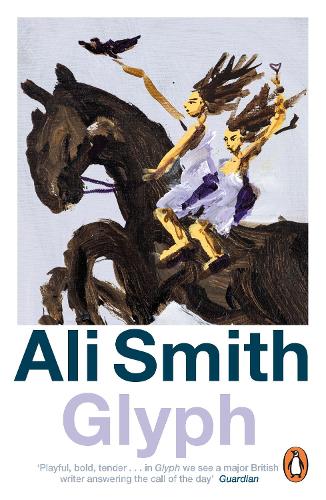
Glyph
Fiction & Poetry, Science Fiction, Fantasy & Horror , Science Fiction & Fantasy
Ali Smith (author)
Paperback Published on: 21/01/2027
Price: £9.99