


Reviews: HELL (1)
“An Excellent translation of Dante's Inferno”
(Hardback)
This is Alasdair Gray’s long-anticipated translation of Dante’s Inferno into what Gray describes as “prosaic English”. So, the first thing to say is that there is nothing prosaic about Gray’s English. It grabs you by the throat and pulls you along at a merry rate, gleefully recounting the descent into Hell. This is exactly what you would expect from the creator of “Lanark” which, after all, is its own descent of this kind.
The story is well-known. Dante, the poet, has lost his way in a terrible and hostile wood when he meets Virgil who leads him on a journey into the inferno because it has been ordained in Heaven that a mortal poet should see Hell, and then describe it. The fear of the punishments of Hell should persuade others to live “a righteous, sober and godly life” rather suffer eternal torment. That is the task that Dante is given and the purpose of his journey, led by Virgil, through the circles of hell.
There are a number of things that Alasdair Gray makes very clear in his translation. The reason why Dante encounters so many Tuscans in hell is that he can speak their language, especially if they are Florentine. This accounts for the obscurity of many of the figures that we come across. Dante’s audience would know who Filippo Argenti or the tyrant Azzolino or Guido Guerra are, but we do not. It is like having a hell populated by Angela Leadsom, Nigel Farage and the like. They may be well-known now, but in a few hundred years’ time, I doubt it.
There are the figures from Greek mythology in particular, and these are known because they are still part of the popular culture, especially Hercules, Achilles and the many others mentioned. There are notorious figures from history, such as Attila the Hun. The point however is to show us that they are at the mercy of Harpies and Furies and Gorgons, of Demons and fiends, and that they are subjected to unspeakable and unremitting torment.
The crime of the century (the fourteenth century) gets a mention. Guy de Montfort, a grandson of King John of England, is in hell for the murder of his cousin in the Cathedral of Viterbo, as do other spectacular crimes from throughout the centuries. Brutus and Cassius are confined in the lowest circle of hell, alongside Judas Iscariot. There are whole chapters on the doom of sectarians, falsifiers, forgers, rebels and traitors, which Alasdair Gray gleefully translates into doom-laden prose.
The denunciation of capitalism “which is judged as foul as sodomy” is a particular delight, and will cause offence to people on all sides of the argument about modern morality. It is easy to get the feeling that Alasdair Gray was enjoying himself enormously at that point. It is of course Dante who is making the comparison, but Gray is clearly revelling in it.
There are some comparisons that, in my view, do not work. Gray translates Guelph (supporters of the Pope) and Ghibelline (supporters of the Emperor) as Whig and Tory, and says that the similarity between the two is the difference between old and new money. My view is that this is both a misreading of fourteenth- and eighteenth-century history, but that does not really matter. The real problem is that only one of those terms is in use today, and that the comparison will not make sense to the ordinary reader. That having been said, I cannot think of a better one.
What Gray has given us is an exciting, ribald and exuberant translation of Dante’s Inferno into English. It is a translation for the modern reader. Enjoy it.
Page of 1
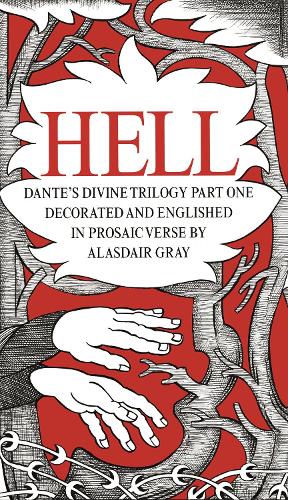
HELL: Dante's Divine Trilogy Part One. Decorated and Englished in Prosaic Verse by Alasdair Gray
Fiction & Poetry, Classics & Modern Classics, Poetry
Alasdair Gray (author) , Dante Alighieri (author)
Hardback Published on: 04/10/2018
Price: £14.99