


Reviews: Lean Fall Stand (11)
“A daring and poignant novel”
(Paperback)
I was caught off guard at just how cleverly this book manipulated the English language to place you in the character's shoes. I found the story to be equal parts heart-breaking and fascinating, and I'm sure it will stay with me for a long time.
“Another remarkable book from a wonderful author”
(Hardback)
/ _ |
A new Jon McGregor novel would be the highlight of any year – and this one will I can confidently say be a literary highlight of 2021.
The wonderful Reservoir 13 starts as a missing girl mystery but almost immediately becomes an multi-voice exploration of how quotidian dramas play out against the rhythmic seasons of village life and the natural world, while time continues to pass incessantly.
This book his latest (due to be published in April 2021) starts as a book around polar exploration (the author having visited the Antarctic with the British Antarctic Survey around 20 years ago I believe) and about survival in a calamity in extreme conditions. But over time it turns into an exploration of communication and story telling, and an examination of how true heroism can simply be found in the need to navigate and adapt to unexpected challenges of circumstance in normal life.
The blurb of the book already gives substantial information on the plot (perhaps even slightly too much – I would recommend not to read it as it dissipates some of the tension of the first part, which while not really the core of the book, still is an essential part of it) and at this stage (4 months prior to publication) I would not really want to add any more.
As I said communication and storytelling as a theme recurs through the novel – and in fact it’s the retrospective exploration of this idea that helped me realise the importance of the first section. We have: the contradictions of the initial training and its inability to map to a real world crisis; lost radios and then intermittent radio contact; uncharged and unused satellite phones; drifting GPS co-ordinates which tell a story which is not appreciated until too late; scheduled radio check ins with base which serve as a sign that all is well – with the absence of communication triggering an emergency.
In the second section we see the difficulty of expressing oneself in a foreign language; Bridget as someone who would be a great listener if only she could stop talking; Robert’s incessant relaying of tales of his exploration on his trips home and Anna’s final and ominously prescient request for silence; Anna’s love of the silence of the meetings of the Society of Friends; the different languages and alien communications of medical and legal professionals and technical experts.; Anna’s son’s comments on her monosyllabic shut downs; the story telling of an inquest report (and the trade off between having a story that makes sense to the victim’s family and not having any apportionment or admittance of guilt); speech therapy and communication workarounds (which then form the base of the third section).
One of McGregor’s greatest skills is his remarkable ability to voice a community: the street in his debut novel “If Nobody Speaks of Remarkable Things”, the chorus of voices in the remarkable “Even The Dogs” and of course the village in “Reservoir 13”. We see this perhaps most strongly in all of his writing in the book’s third section as the therapy group come together; by the final scene of the “showing” we are both able to identify immediately individual voices, and to understand the story they are trying to tell, even though a superficial examination of the voices would render them largely meaningless.
Other links to his previous books:
Here of course we have a group of people who would very much like to speak of normal things (let alone remarkable ones) but struggle to do so.
Readers of “Even The Dogs” will remember an inquest – and a man called Robert whose detailed and accurate testimony would be crucial but is missing (albeit for a very different reason).
Readers of “Reservoir 13” will see that the author’s ability to capture the natural cycles of an English village apply equally the breathtaking but harsh Antarctic landscape (and cleverly not just in the author’s own words but in his ability to capture the ability of Robert and a dancer, to capture this in slurred speech and mirrored movement.
Strongly recommended.
/ _ I
“How Language Helps Us Explore New Worlds”
(Paperback)
Robert 'Doc' Wright has spent years of his life working in the Antarctic as a technician. When things go horribly wrong during what will turn out to be his last trip, Doc suffers an injury that means he is unable to tell anyone what happened out there. Meanwhile, he and his family have to find new ways to live and communicate on his return.
Split into sections, only we, the readers are able to see what happened both on the ice and afterwards.
This is a fascinating book about language and exploration. The alien landscape of the antarctic and the constantly shifting weather and even at times, the ground beneath your feet, make an apt metaphor for what happens to someone trying to piece their life together after a brain injury and the ways that Doc and those who care for him find to communicate with each other is the bridge that spans the pre and post stroke world.
“Translations”
(Paperback)
Before reading this novel, I think I had mentally archived it as another polar exploration/disaster story but that is a surprisingly minor part/red herring in the detail of what is a truly beautiful book.
The cover and blurb are a bit of a misnomer for this book-which is actually a story about language, communication, and care.
How do we tell our stories? How do we communicate? how do we connect with people, if we lose the power of speech, or the ability to communicate our thoughts in a linear way.
This novel shows us in a very tender way ,how the fragments of ourselves and the world around us can still be translated or depicted by the smaller things we take for granted. It is about the human spirit being hard wired to repair itself. Lots of metaphors for spring and regrowth within the novel subtly show this
The main character experiences a life changing event exactly at the moment when the ability to communicate, call for help is essential.
It is a poetic, multi-layered novel that can be read as a tender story about what it means to recover, what it means to care for somebody and how your identity can suddenly become lost or fractured when you move from full health to illness, impairment, or disability . It looks at not only the impact of this on the main character: Doc but also how this affects his wife ,who goes from a successful academic researcher to a full time carer overnight. It shines a light on the way people regroup, reroute and accept irreversible life changes.
It can also be read as a highly creative novel that explores the essence of language and how we can still convey our stories, histories, dreams and needs when we no longer have the words or the words in the right order to do so.
“Lean Fall Stand by Jon McGregor”
(Hardback)
Jon McGregor is a remarkable writer. He can take a deeply upsetting subject and write in such a lyrical way that the reader is transfixed by the beauty of the writing and lured into the story.
In this case Robert, Luke and Thomas are scientists on an Antarctic expedition setting about their daily task of measuring and producing photographic evidence of their findings when a storm unleashes it self on them. During the storm, Robert, known as Doc, and the eldest of them as a stroke. This is disastrous and means that they have to be evacuated. Thomas cannot be found until it is far too late.
Robert as to be flown to a hospital in Santiago, Chile and he is flown from there to a hospital in Cambridge. HIs wife, Anna, flew out to Santiago to be with Robert, and flies back with him to Cambridge. His children, Frank and Sara, are in constant contact with her and visit as and when their jobs allow.
The rest of the book revolves around Robert’s recovery process in Cambridge. The skill of the writing is such that we become intensely aware of the frustrations caused by not being able to communicate. It is not just Robert’s frustration either. It is the frustration of all those people who are trying to understand him. Robert as to learn non-verbal methods of communication. For instance, as he is not able to shake his head, Robert has to learn a different way of saying “No”. This is important so that the doctors can assess the damage to his brain, but also important for answering questions like “Would you like a cup of tea?” Then there is the problem of drinking simple tasks like drinking a cup of tea.
McGregor finds a way through language of conveying all of this to the reader. It is a bravura performance, an extraordinary tour de force. McGregor takes us through the process of recovery as it affects Robert and all those people around him, both professionals and is family. A further complication is that there has to be an inquest into Thomas’ death. Robert has to give evidence. Frank, his son, is worried that there will be an attempt to blame Robert. There is a group therapy session with carers present, at which various members of the group are assigned specific tasks to resolve. There is the dance therapy session, which is not about dance, but expressiveness. McGregor sows us that the process of recovery from a stroke is both complex and individual.
McGregor leads us into the mind of the patient, and sows us the concerns of all those who have been affected by the stroke in any way. This is an extraordinarily complex story told wit incredible skill and beauty of language. It is a book that is well worth reading.
Page of 3
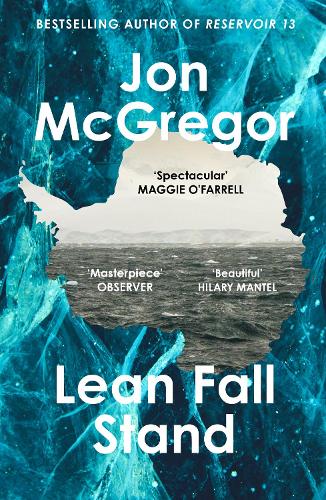
Lean Fall Stand
Fiction & Poetry, Modern & Contemporary Fiction
Jon McGregor (author)
Paperback Published on: 31/03/2022
Price: £8.99