


Reviews: Macbeth (1)
“History, Mythology, & Drama”
(Paperback)
Having already read (and reviewed) Nick Aitchison’s book on the Stone of Destiny, and making a return visit to Perthshire, I thought it a good idea to read his forensic analysis of Macbeth. This is a review of the original 1999 edition, comprising an introduction and five chapters. The book is illustrated with black and white photographs and a number of maps. There are endnotes, a bibliography, and an index.
In his introduction the author writes, “While concentrating on the historical Macbeth, the aim here is to provide a wide-ranging survey of Macbeth in all his forms and at the same time demonstrate the manner in which the historical, mythological and dramatic Macbeths are inextricably linked.”
The first chapter is entitled ‘Scotland in the Age of Macbeth’. Commencing with an examination of the meagre documentary sources – what exists is “terse and obscure” – the author nevertheless explores the nation’s social and political organisation in the tenth and eleventh centuries. He ends by concentrating on Moray, clearly demonstrating this region’s sense of separateness from the rest of Scotland: the Irish annals refer to Moray’s rulers as kings. He also focuses on the sense of perpetual political strife there: Duncan I, killed by Macbeth, was “the fourth Scottish king to have been killed in Moray in 140 years.”
‘The Path to the Throne’ is the title of chapter two, Aitchison takes us from Macbeth’s birth through to the eve of his accession, noting that, “Although it is not possible to write a historical biography in the recognised sense, the available texts present us with a series of ‘snapshots’ of Macbeth the man.” Here the author makes one major failing by not even attempting to explain etymologically how references in Viking sagas to ‘Karl Hundason’ are to King Duncan.
Macbeth as king is covered in the third chapter. Aitchison asserts that “the paucity of contemporary textual sources means that only seven events may be identified during Macbeth’s [seventeen-year] reign.” Prior to reading this book I had been doubtful of one of those events, namely the claim that Macbeth had made a pilgrimage to Rome, based as it is on only one source. But Aitchison here places it in context of royal pilgrimages generally. Although Macbeth is the only Scottish king to make the trip, “Going on pilgrimage to Rome was an important and fashionable feature of eleventh century insular kingship, involving kings of widely different status, from Irish petty kings to the mighty Cnut.” Indeed, Cnut went twice and, like Macbeth, was also lauded in the chronicles for his generosity whilst there.
Chapter four – ‘The Making of the Myth’ – asks “How did the historical Macbeth become the personification of ambition and evil famously portrayed by Shakespeare?” Since such an investigation involves detailed readings, sometimes line by line, of original near-contemporary sources, it might have been better to have had this as the book’s first chapter. But we can see here, nevertheless, the stages in which the strands of the myth were interwoven. At least twenty years before Shakespeare’s play, it is interesting that James VI’s own tutor, George Buchanan, (in his ‘History of Scotland’ of 1582) wrote with regard to King Macbeth that, “Some of our writers relate a number of fables, more adapted to theatrical representation … than history.”
The final chapter is called ‘In Search of Macbeth’ and explores the places linked to his life and to the myths of his life, an exploration that the author refers to as “topographical mythology”. Having travelled on my recent visit to Perthshire from Birnam to Dunsinane, and having previously visited Scone and Glamis, Aitchison’s words were of some value.
Aitchison sifts carefully and intelligently through the meagre evidence available. Yet, perforce, there are too many ‘probables’ and ‘must haves’ for my liking, too many “intriguing possibilities”. But he is at least honest about his suppositions and open with his readers about the scanty sources from which he derives his evidence. He is objective with the evidence, possessing no prior agenda or axe to grind. His book is therefore of practical value to anyone with an interest in both the man and the myth.
Page of 1
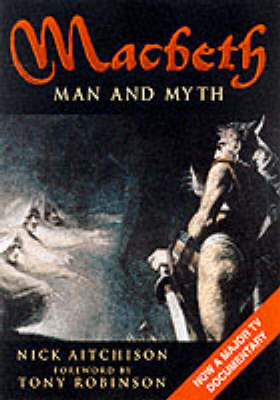
Macbeth: Man and Myth
Non-Fiction, Screen & Performing Arts, Theatre, Shakespeare
N. B. Aitchison (author) , Tony Robinson (foreword)
Paperback Published on: 23/11/2000
Price: £12.99