


Reviews: Margaret the First (3)
“Margaret the First: an unusual book about an incredible woman!”
(Hardback)
Who was Margaret the First? You may well ask, and unless you do some extra research this book will not really give you the biographical facts usually recited about this real person who endured exile and relative poverty as a result of Civil War and loss of royal favour. If you track this book down, however, you will learn a lot about how this character felt, thought and something of her determination to live and write in her own way, based on the books that survive her.
Margaret made a marriage for love to William Cavendish at the start of Queen Henrietta Maria’s exile at the beginning of the English Civil War. He encourages her to write plays, poems and other wild, visionary pieces of stories, fantasies and new ideas. When she returns to England, and William eventually reclaims his family lands and houses, she writes for publication, in many ways being one of the first noble ladies to do so, especially as her work includes the new philosophies and discoveries which filled the interests of so many in Restoration London. She attends the Royal Society, being the first woman to do so and the last one for two hundred years. She comes to the attention of Samuel Pepys and other writers and diarists, as much for her amazing self designed clothes and grand entrances to theatres as her writing.
Despite her writing being in print at the moment, and at many stages since her relatively early death, not much is written about her compared with, for example, Pepys. She was not writing a diary, and she did not begin a particular writing genre such as the novel so her work was and is difficult to catagorise. Such people as Virginia Woolf admired her, but it is possible to visit one of the family houses and not read anything about her. She obviously, from this book, had an incredible imagination that took ideas from others and embellished them into extraordinary visions. She saw nature in amazing ways, rivers had sounds and personalities, the world to her was unlimited by time and space.
This short book, novel, switches viewpoints between the first and third person, revealing where Margaret was living and seeing it through her eyes. It is not at all biographical in the traditional sense, but the confidence of the style is that the reader seems to see, hear and smell through Margaret’s senses, which can make it a little overwhelming. The length of the book would suggest it is a quick read, but I found it too intense to read quickly or in one sitting. Technically it is almost a stream of consciousness, as Dutton slides between seeing nature as a cathedral, and details the mess and noise of a poor area of London. So while this book lacks a line of story in the ordinary sense, the reader gets the sense of what her life was actually like. She had no children, but as William was already provided with heirs from his first marriage, he chooses to remain devoted to her as she did to him.
So this is a difficult book to describe and convince another to read, but it is as extraordinary as it seems the lady was herself. Which is some achievement.
“An extraordinary woman ahead of her time....”
(Hardback)
This is the fictionalised story of Margaret Cavendish, a pioneering 17th century writer and wife of the aristocrat William Cavendish. This is not an ordinary historical novel ; it is clever, ambitious and intelligent just like its subject. It celebrates the life of a singular woman who wrote poetry, drama, philosophy and science fiction and also was the first woman to be invited to the Royal Society of Science.
Danielle Dutton's use of language and narration makes this brilliant novel a triumph.
“This book may be short but it packs a punch!”
(Paperback)
A fascinating portrait of Margaret Cavendish - whose ambitions and actions were ahead of her time. She was the first women to speak at the new Royal Society and the first Englishwoman to write for publication.
The novel follows Margaret through her childhood, to exile during the English Civil War, to the Restoration and its period of stability after.
Margaret is perceived as odd and quiet - so she turns to paper & ink to help process her thoughts and vivid imagination - her book Blazing World can arguably be seen as the foundations for fantasy and science fiction writing. Her views face outrage and acclaim - causing the nickname 'Mad Madge'.
Dutton writes wonderful a stream of consciousness full of vivid descriptions which make for a wonderfully intimate read - helping bring Margaret to life off the page. Dutton also writes beautiful phrases - which are witty, smart and also melancholic.
"It broke upon her with the rain. After nearly two years of stagnation, fearing her wit run dry, as the rains washed over the forest, muddying roads, and the bluebells bloomed, Margaret sat and wrote..."
I've studied Restoration London, Samuel Pepys' Diary and early modern medicine so I thought the attention to historical detail was perfect. For instance Margaret is victim to many ridiculous treatments such as fresh ram excrement rubbed on her belly for a fertility treatment. I also enjoyed how Dutton remarks on how the loss and destruction caused by the war could not be undone by the Restoration - making it seem almost anticlimactic.
I highly recommend this book to anyone who enjoys reading about 17th Century England and pioneering women. It's also only 160 pages!
Page of 1
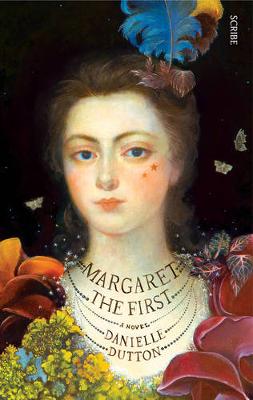
Margaret the First
Fiction & Poetry, Modern & Contemporary Fiction
Danielle Dutton (author)
Hardback Published on: 08/12/2016
Price: £12.99