


Reviews: Measuring What Counts (1)
“Especially Relevant Now”
(Paperback)
This is very much a book for these unprecedented times. The thinking behind it, and the recommendations it makes, could set the course for responses to the coronavirus crisis which deliver equitable and sustainable societies in the future.
It begins with three “existential crises: a climate crisis, and inequality crisis, and a crisis in democracy” which have not been reflected in the way we measure economic performance, especially by the standard measure of GDP. Wrong measurements and indicators, the book maintains, will inevitably lead to wrong policies, no improvement in well-being and a consequent distrust in government and public institutions. For example, in some countries, not accounting properly for the benefits of a welfare state has led to a leaner welfare state. Thus a path is charted between the economic crisis and Great Recession of 2008 and the political crisis of 2016.
The book is offered as a personal perspective of the “Chairs of the Organisation for Economic Co-Operation and Development-hosted High-Level Expert Group on the Measurement of Economic Performance and Social Progress (HLEG)”. It is wide ranging, clear and readable, linking a number of areas where well-being indicators for people and societies could positively guide the policy cycle through agenda setting, policy formulation, implementation and monitoring to evaluation.
There’s extensive discussion of economic insecurity, and its effects on several areas of well-being. The resonances between the effects of the downturn of 2008 and those which are beginning to emerge with the current coronavirus crisis are obvious. For example, an increased level of corporate bankruptcies leads to a destruction of institutional knowledge and personal economic insecurity. The consequences for individuals where “…more than 40% of people in OECD countries lack the financial liquid assets that would prevent them falling into poverty if they had to forego three months of income” will become increasingly clear in the weeks ahead. We are already realising the problems which will be faced by young people attempting to enter the job market. Previous crises have left permanent scars on them, and reducing their long term well-being. Early analysis suggests that the brunt of the economic effects of the pandemic is felt by those who are already struggling: the same was true of the recession.
In his “Capital and Ideology”, Thomas Piketty notes the shared experience of the two world wars, which “disrupted all existing social, economic and political dynamics”. The current pandemic will inevitably do the same. “Each such switch point opens the way to a large number of possible future trajectories”, says Piketty. When we read that more than 40 million people, the equivalent of one in four US workers, have filed for unemployment benefits since the pandemic took hold (New York Times, 28.05.20), we are clearly at a switch point.
Better and more wide ranging metrics, such as those outlined in this book, would help us follow a trajectory which helped to minimise the shocks and the long-term reduction in well-being. There might even be an opportunity to deliver equitable and sustainable societies in the future.
Page of 1
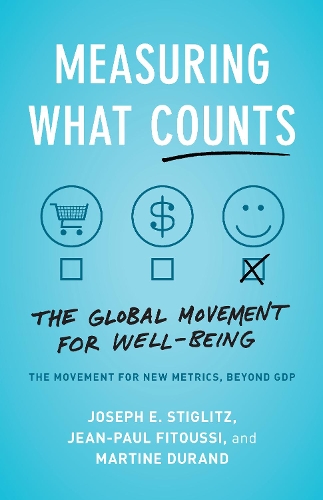
Measuring What Counts: The Global Movement for Well-Being
Non-Fiction, Business, Finance & Law, Economics, Education
Joseph E. Stiglitz (author) , Jean-Paul Fitoussi (author) , Martine Durand (author)
Paperback Published on: 16/01/2020
Price: £12.99