


Reviews: Munich (14)
“Thriller by numbers”
(Hardback)
While there is something formulaic about Robert Harris's fiction, it never seems to fail. The recipe is: take an historical event, mix some flawed but essentially good characters, stir in some fundamentally evil baddies from central casting, simulate some suspense then finish with a surprise. It works every time but perhaps this is how all great writers work. Anyway It seems, at times, a little more obvious here. However the subject is a fantastic one and all of us have the image of Chamberlain waving that piece of paper at Heston (presumably now Heathrow ) Airport ingrained in our brains. Here is the story leading up to that momentous occasion which tries to over turn the image of the prime minister as an appeaser: a view carefully stoked by Churchill. From the opening page of the book I felt I was watching a film - and then being surprised that I wasn't as the images of the events and characters in my head were so vivid. Finally I have to say that I didn't look at the map once.
“Brilliant”
(Hardback)
Harris' style is brilliant. He mixes fictional detail with historical accuracy to create a dramatic novel that will enlighten and entertain.
“Fiction based on fact!”
(Paperback)
Robert Harris has written some excellent readable books over the years. Pompeii and The Ghost come to mind.
If Munich was purely fiction, this would have been very well written! This was based on a historical fact. Making it less interesting.
I have given it a 3 star due to my love of the other books.
“Facts Overshadow Fiction in Nuanced Novel ”
(Hardback)
That Neville Chamberlain remains ‘the most maligned and vilified of 20th century British prime ministers,’ according to his biographer Andrew Crozier, will only surprise a few. What will prove surprising to many, however, is the fact that Chamberlain – especially given what scholar Robert J. Beck says about ‘few[er] episodes of diplomatic history … attract[ing] as much scholarly attention as the Munich Conference’ – has never appeared as a fictional character. Until this summer, that is.
Twenty-five years after he published the best-seller Fatherland, a dystopian alternate history featuring a septuagenarian Adolf Hitler presiding over a Greater German Reich, Robert Harris revisits Nazi Germany to fashion fiction around fact over four days at the end of September 1938. The background is Hitler’s territorial claims in Europe, specifically his impending annexation of Czechoslovakia (day one), which British Prime Minister Chamberlain – aided by Italian dictator Mussolini and his French equivalent Daladier – manages to postpone (day two) upon agreeing to attend a meeting in Munich the following day. After flying out to Hitler’s new palace, the Führerbau, Chamberlain and company agree to the Sudetenland – German-speaking borderlands of Czechoslovakia – being incorporated into the Third Reich (day three). Before flying back, Chamberlain convenes with Hitler so that the latter can put his signature to an agreement written up by the former stating their countries’ desire never to go to war with one another again (day four).
Within this factual canvas, Harris successfully weaves a fictional conspiracy through a thread comprising the convergence of dual storylines: Paul Hartmann, a pro-German, anti-Hitler diplomat, endeavours to derail the conference by passing top secret documents detailing the Führer’s bellicose intentions to his former Oxford chum, High Legat, a Foreign Office official seconded to Downing Street who is also a delegate at Munich. It is believed that the prevention of an agreement being signed will provoke an uprising by the Wehrmacht and thereby prevent a European, even global, conflagration. Although we know the ending (deal signed, war waged, plots suppressed), Harris has the unique ability to cause readers to suspend their belief in historical reality: in alternating chapters, those accompanying Hartmann on Hitler’s train and Legat on Chamberlain’s plane believe a different outcome is a distinct possibility.
For all the cloak-and-dagger atmospherics in Nazified Munich, though, Munich is too light a fictionalised treatment of a heavyweight event for it to be considered as thrilling as its billing. Based on wide-ranging research – illustrated by works cited and illuminated through sites visited – it will be best regarded as a fictional portrait of Chamberlain, a character sympathetically portrayed for his pioneering of shuttle diplomacy, that will contribute towards his factual reappraisal. For those wishing to indulge the Chamberlain caricature as an “umbrella-toting utopian”, however, Munich: The Man Who Said No! (published as an eBook in August) will prove mildly appealing since author David Laws swims out from the shallows of fact into the depths of fiction, albeit into choppy waters.
Page of 3
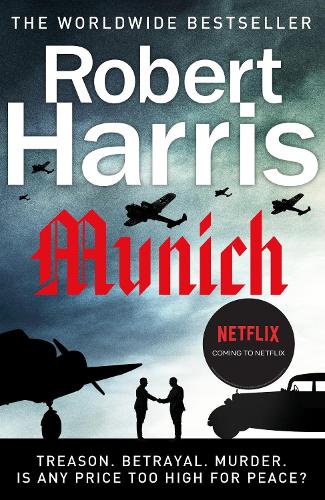
Munich
Fiction & Poetry, Modern & Contemporary Fiction
Robert Harris (author)
Paperback Published on: 14/06/2018
Price: £9.99