


Reviews: Numbers (1)
“So Much Fun!”
(Hardback)
You know me: I love finding and sharing fun facts. Because this is a book about numbers, I decided to share one fact for each of the ten chapters. Here they are…
Our calendar used to have ten “moonths”. September, October, November and December were named because they were months seven through ten. When two months (January and February) were added because there are usually twelve full moons in a year, no one bothered to change their names. Also, July and August used to be known as Quintilis and Sextilis.
“The year numbering system widely used today was invented by a monk called Dionysius Exiguus in the sixth century (his name may sound grand, but it translates as ‘Dennis the Short’).”
The Mayans used a picture of an upside down turtle shell to represent zero.
Cicadas are distant cousins of shrimp and lobsters. Apparently, they taste like asparagus. (Not all of the fun facts in this book are specifically about numbers, even though the reason we learn about cicadas is number related.)
“Every non-prime number can be deconstructed into prime numbers multiplied together (called ‘prime factors’).”
Pi fun facts:
* We know pi to 62.8 trillion digits
* “8 is the most common digit in the first trillion digits”
* There are six nines in a row at position 768
* “It takes until the 17,387,594,880th digit to find the sequence 0123456789.”
In the early nineteenth century, Reverend Jeremiah Trist built circular homes for each of his five daughters in the Cornish village of Veryan. He reasoned that there’d be no corners for the devil to hide in. If only he’d read this book first, he’d know that circles actually have an infinite number of corners. Oops!
Your maths teacher lied to you: the sum of the angles of a triangle don’t always equal 180 degrees. That only works for flat surfaces. Triangles drawn on spheres can add up to 540 degrees! If you draw a circle on a hyperbolic paraboloid (think Pringles), they’ll add up to less than 180 degrees.
Companies use graph theory to decide the route their delivery drivers take. “Such a dilemma is called a Travelling Salesman Problem (TSP) or vehicle routing problem.”
To say Francis Galton had some problematic ideas is well and truly understating it. He also came up with a way of cutting cakes to make them stay fresh longer. Although, to be fair, who expects there to be leftover cake on day three anyway?
In a group of 30 people, there is a 71% chance that two of them will share a birthday. In a group of 70 people, there is a 99.9% chance that two of them will share a birthday.
Exponential growth means that if you invested $1 in the US stock market in 1900, it would now be worth almost $70,000.
The Infinity Hotel, also called Hilbert’s Hotel, will mess with your mind. It gets to the point where an infinite number of coaches carrying an infinite number of people results in there being an infinite number of occupied rooms as well as an infinite number of unoccupied rooms.
Doesn’t add up to ten, does it? Okay, so maybe I failed at the one fact per chapter thing but only because there were too many fun facts I wanted to be able to refer to later.
This was a quick read. I mostly found it easy to follow, although infinity twisted my brain in knots and I’m not sure I could explain graph theory to you (I expect to forget everything I learned about it by this time tomorrow).
Before I found this book at my library, I’d never heard of the Things You Should Know series. Now I want to know about all of the things.
Because I love pi so much now, I’m tempted to give this book pi out of five stars but that would be underselling the fun I had reading it. Instead, I’m rounding up from 4.5 stars.
Page of 1
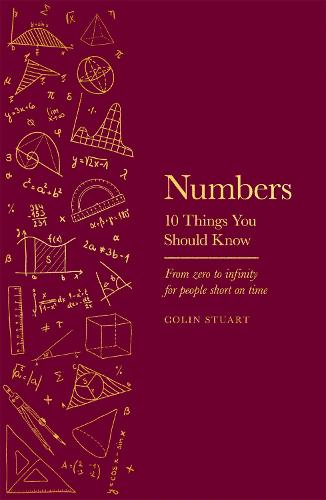
Numbers: 10 Things You Should Know
Non-Fiction, Science & Maths, Popular Science
Colin Stuart (author)
Hardback Published on: 01/09/2022
Price: £10.99