


Reviews: The Day Without Yesterday (1)
“A great blend of history, science and fiction.”
(Hardback)
'The Day Without Yesterday', like the other two books in Clark’s series, charts the dynamics between scientific discovery and the context in which those discoveries sit, a context much overlooked as today we take these discoveries for granted. The complex relationship between science and religion is a key thread, as it was in Clark’s previous two novels. The scene in which Lemaître voices his ambition of becoming a priest is especially powerful, as his comrades query him by saying that they thought he wanted to be a physicist. Lemaître is genuinely baffled by the idea that he could not be both priest and scientist – and he is of course correct.
In 'The Day Without Yesterday' a stronger question of morality is introduced. Einstein is horrified to discover that one of his fellow scientists worked on the production of poison gas for use in the trenches, but is even more horrified when the wife of his friend and fellow scientist shoots herself, unable to forgive her husband, Haber, for the pain and suffering caused by the use of gas. Haber is remembered today as Nobel Prize winning scientist whose discoveries are used to create fertiliser required to provide the world’s population with food. His role in the deaths of soldiers a hundred years ago are conveniently forgotten as ‘the greater good’ has obliterated the memory of that harrowing time. This novel brings the terror and unprecedented scale of warfare vividly back to life, reminding us that for those living through the war, patriotism and moral stance had to do battle with each other, played out in the field of scientific progress.
Another theme which this novel shares with the other books is conflict between scientific rivals. We saw how Hooke and Newton’s bitter feud was sparked by one’s admiration for the other, an admiration which was ignored and trampled. Similarly Lemaître is rejected by Einstein, but towards the close of the novel the two scientists engage in a fascinating conversation which the author manages to turn into a fitting conclusion for the entire series.
Lemaître quotes Galileo towards the close of the story, saying that ‘the Bible tells us how to go to Heaven, not how Heaven goes,’ which is a good summary of the theme of this series of novels, and brings us full circle. Clark’s series serve as a discussion of science and society in a fictionalised form, crossing genre boundaries successfully, and prompting serious thought which is alarmingly relevant to today. Highly recommended reading for anybody with an interest in history and science.
Page of 1
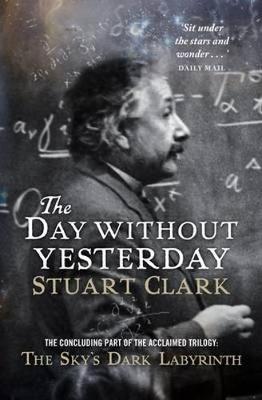
The Day Without Yesterday
Fiction & Poetry, Modern & Contemporary Fiction
Stuart Clark (author)
Paperback Published on: 03/04/2014
Price: £8.99