


Reviews: The Ghost Army (1)
“Fascinating exploits”
(Paperback)
The first thing that struck me with this book was the cover, an old photograph of four soldiers holding up a tank, not in the highway robber sense, but physically holding it in the air! This is clearly impossible and the subtitle/strapline of ‘conning the Third Reich’ gives a big clue, it is not a real tank but an inflatable one. If that doesn’t pique the reader’s interest, I’m not sure what will, and you certainly don’t need to be a student of military history to be fascinated by this book. It is one of those true-life stories that seem to be impossible but merely showcase the ingenuity of man.
The first part of this book covers the work done by the British in deception some detail, but then it goes on to cover how deception was used by the US Army, particularly First US Army Group (the so-called 'Ghost Army') and the 23rd Camouflage Engineers.
Battlefield deception was nothing new, but during World War II it was taken to new heights. This initially was born out of necessity, the Allies (at this time UK, Commonwealth and European) were woefully prepared for war. They were well behind the Germans in the rearmament phase and lost a great deal of artillery, vehicles and equipment during early skirmishes. To win the war they needed to stay in it until they amassed superior power in fighting men and armament. The more they could confuse and delay the enemy the better. From this came superior knowledge and skills in camouflage, the ability to trick the enemy to see what you wanted the to see and the use of mock ups as well as making tanks look like lorries and lorries look like tanks, as the need arises. All perfectly described and in some detail.
Once the US joined the war (after the attack on Pearl Harbor) they were impressed to see what had been achieved by the Allies at short notice and with limited resources and naturally they were keen to do it bigger and better. They had greater resources and the skills of Hollywood to draw from, turning it from the illusionist’s work of ‘smoke and mirrors’ to a big budget extravaganza of sights and sounds. It is here that the book excels.
The tricks they managed to pull off and how they did it are best left to the detail in the book, but some of the human aspects are particularly interesting. The authors have clearly researched well and made use of documents that have remained classified for over fifty years. They have also managed to interview some of the veterans of the ‘Ghost Army’ and their recollections bring a real personal touch. A timely action because there are few of these men still alive. My abiding observation is that these veterans didn’t believe that they were doing anything extraordinary at the time, when many were, remaining modest and humble even when given their voice.
War is tough mentally and physically and not everyone is frontline soldier material. The more practical intellectuals and scientists could work in signals or intelligence services, but what of all those men who work in the arts. Well, this book shows how they played an important role in the conflict by using their specific skills and talent, demonstrating their adaptability and ingenuity. Artists and painters became experts in camouflage, perfecting the art of hiding in plain sight. Set and prop builders created virtual weaponry (including inflatable tanks) that could be moved around battlefronts to sow confusion. Even sound recordists and engineers got in on the action. They recorded the sounds of artillery, the movement of vehicles and tanks, which were broadcast over specially built speakers which in combination with smoke cover to cause terror and confusion.
Even actors who weren’t making films to support the war effort got in on the ‘action’ in Europe.
Some thespians were instructed to fool locals in the bars with misinformation, whilst others were role playing soldiers, some starting the day as a private but somehow ending the day as Majors! It clearly worked as it confused men on both sides of the conflict and must have provided some levity in very dark times.
Overall work of the First US Army Group was so successful that captured German battle maps showed the fictional army stationed just where they were intended.
This reviewer received a free of charge product for review.
Page of 1
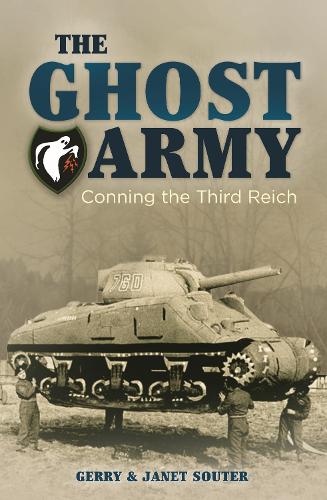
The Ghost Army: Conning the Third Reich
Non-Fiction, History & Politics, Military History, The Second World War
Gerry Souter (author) , Janet Souter (author)
Paperback Published on: 20/05/2019
Price: £9.99