


Reviews: Thomas Becket (4)
“Time to Reassess Thomas”
(Hardback)
This is a good hefty biography of Becket. It is informative on his early education and employment, about which I knew very little. It also gives a balanced account of his disagreements with Henry II. Guy investigates the thorny matter of how sincerely held were Becket’s religious beliefs. He tends towards Becket as more genuinely religious, for longer, than is usually thought. This is no hagiography however, Becket comes across as hasty, too keen to push his principles and privileges and nowhere near canny enough to survive his dealings with Henry.
Henry comes out of it very badly. His word was in no way his bond. I had always thought, although I don’t know why as I could have done the maths, that Henry had the folly of youth excuse for Thomas’ brutal murder. I was wrong. No spring chicken when those intemperate sentiments wishing someone would get rid of the troublesome fellow were expressed; rather a forty year-old man who should have known better. I was also very interested in the motives of the knights who sped across the Channel to avenge their master by slaying a clergyman. According the Guy they were the lowliest of knights, spurred into action by a desire to prove themselves worthy servants of the king. More experienced courtiers may have understood the rhetorical nature of Henry’s pronouncements perhaps. It is clear that Henry had very little if any conscience regarding Thomas’ murder, although it suited him to act the penitent and later take up the cult of St. Thomas.
Another ‘fact’ I had always taken for granted was Thomas’ humble origins. Another ‘fact’ that Guy dispels. Becket was not dragged up from nothing by a gracious king. Guy has a good eye for a lively anecdote, one of which particularly tickled me. During one of the many talks designed to reconcile Thomas and Henry a scene of black comedy unfolded as Thomas met Roger of Pont l’Évêque: they ‘raised their crosses against each other like lances in a tournament.’ Becket was a martial as well as clerical man, and was quite prepared to use whatever weapons necessary in his cause.
A much broader and clearer picture of Thomas emerges from this book, as a person not a martyr or cynic. He was not easy to deal with. Unyielding and demanding, his failure to gain or keep support from his fellow clergy increased the likelihood of his coming to a bad end. The audacity and sacrilegious behaviour of the knights who set out to teach him who ruled the realm is still incredible all these years later. The boldness Thomas showed in refusing to cower from them or retreat is an act of unthinkable bravery and stubbornness. Well, unthinkable in most men; John Guy spends 300+ pages demonstrating that Thomas Becket was certainly not most men.
“Highly readable history”
(Paperback)
John Guy performs a miracle of historical writing in bringing to life in vivid colours events and characters of 900 years ago. His flowing, robust style makes for an immersive read, but his narrative is also reassuringly well-grounded in reliable sources which he frequently refers to - this is no flight of fancy or fiction, but a thoroughly researched, cogently argued account with the ring of conviction about it. Nobody comes out of this book unscathed, neither Henry for his duplicity nor Becket for his arrogance, and by the close I felt I had drawn within touching distance of flesh-and-blood individuals, and the passions and anxieties that had driven them. A well-balanced, authoritative history, but also an immensely enjoyable read.
“LIke a historical novel”
(Hardback)
This is a historical biography that reads like a novel. It's very well written and makes the story really engaging. It makes Becket seem real, balancing his faults with his endurance and heroism but I was really shocked how much of a monster Henry II seems to have been. A case study in how absolute power corrupts absolutely. If you have any interest in Becket and Henry II you need this book.
“Thomas Becket”
(Hardback)
Thomas Becket is John Guy’s thrilling, revisionist biography of one the most controversial yet revered figures in British history – “the man who sought to reform a nation, dared to defy his king, and laid down his life to defend his sacred honour.”
The basics of Becket’s life story are quite well-known. Born in 1120 into a lower middle class Norman family, Becket eventually rose, despite poor health and apparently rather unremarkable abilities, to become the second most powerful man in the country, second only to Henry II himself. At the height of his power Becket led seven hundred knights into battle, brokered peace between nations, influenced kings and held the ear of the Pope. Becket’s fall though proved to be just as dramatic as his rise. Then Archbishop of Canterbury, Becket was murdered in his own cathedral in 1170 by those loyal to King Henry II for daring to side with the Pope.
Thomas Becket is no simple retelling of these events though. With this book John Guy brings the colossal figure of Becket vividly to life and in doing so illuminates aspects of his character seldom seen in previous biographies. Seeking to separate facts from centuries of romanticising and mythmaking, Guy sheds new light on the relationship between Becket and Henry II and casts doubt on the prevailing belief that the two men were once great friends [the class barrier and Henry’s highhandedness making true friendship unlikely].
Guy also examines in commendable detail Becket’s rather perplexingly dramatic transformation from fearsome military man and effectual bureaucrat into a pious and devoted man of the Church. Guy offers convincing evidence that this transformation was really brought about by a combination of pride and arrogance rather than by a true religious epiphany. While Becket clearly was committed to the cause of the Church, it is likely that he was influenced as much by selfish reasons as by piety. The evidence of Becket’s capriciousness and the strength of his temper are certainly at odds with the saintly image of Becket that has been fostered over the centuries. Thomas Becket therefore provides a rounded picture of the man behind the myth and so explains how such contradictory opinions of Becket came to coexist.
John Guy is certainly a meticulous and inventive researcher. During the compiling of material for Thomas Becket, Guy discovered the list of books that made up Becket’s library during his time in exile and through studying these polemic titles, he was able to gain new insight into Becket’s ambition and state of mind during this period. Perhaps even more impressively, Guy also discovered a few of Becket’s personal copies of volumes from this library, one of which included marginalia written by the great man himself. It is the unique insights of this kind as well as Guy’s detailed analysis and engaging writing style which really make Thomas Becket a standout biography and authoritative historic volume.
As John Guy comments, the story of Thomas Becket is the story of an enigma, as well as of one of the most tumultuous periods in English history. Through detailed research and by drawing on a vast range of contemporary records and person accounts [the section detailing the earliest biographers of Becket is particularly interesting and is useful for contextualising and evaluating the information that follows] in Thomas Becket Guy has produced a detailed, vivid and exhilarating account of the life of a remarkable man, the dramatic times in which he lived and the pivotal role that he played in British history.
Page of 1
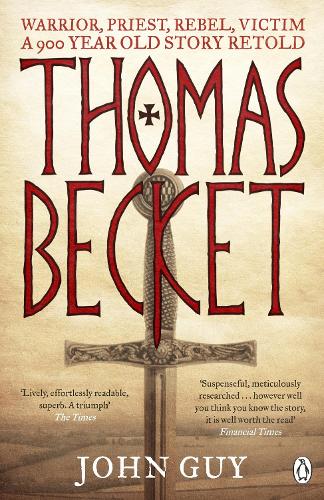
Thomas Becket: Warrior, Priest, Rebel, Victim: A 900-Year-Old Story Retold
Non-Fiction, History & Politics, British History, Medieval Britain
John Guy (author)
Paperback Published on: 25/04/2013
Price: £12.99