


Reviews: Timekeepers (2)
“Take Your Time With This One”
(Paperback)
This reads less like a book and more like a conversation with a passionate time enthusiast. The subjects that Garfield encapsulates into the mammoth theme of time can seem utterly random, but he manages to bring them back to his central focus: human obsession with calculating, tracking and beating the clock.
This is partly because despite time being structured for human consumption – seconds, minutes, hours, days, weeks, years – it is impossible to pin down. It doesn’t just exist in our imaginations (the earth rotates, and so day and night happens – our bodies acclimatise to routine and time is inevitable) and yet so much of what we understand about time is abstract. Garfield does an admirable job of trying to piece the scattered fragments back together.
I found this book as paradoxical as time itself: if I’d tried to read it quicker, I would have enjoyed it less, but because I ‘took my time’ with it, the complex task of trying to organise time into a narrative became thought-provoking rather than dull. An enjoyable read.
“This is a book running on Northern Line time.”
(Hardback)
I received this copy from the publisher via NetGalley in exchange for an honest review
This book started well – with the author leaving the science of time “to the physicists and Doctor Who fanatics, and taking the rational Groucho Marx line on all of this: time flies like an arrow but fruit flies like a banana” and quickly getting on to “How the French Messed up the Calendar” and tried to stop time: “2005 had not been a great year, and 2006 had all the potential to be worse, and so they would symbolically try to stop time by singing some songs and smashing up a few grandfather clocks. Astonishingly, it didn’t work”. After some amusing anecdotes it was onto the serious (and very interesting) business of how the evolution of the railways brought about the synchronisation of time around Europe, and then the world.
From then on, I felt that the book lost its way a little. There continued to be fascinating facts (such as why pop songs had to last 3 minutes) and humour, but the anecdotes became increasingly drawn out, especially in the sections about Swiss watchmaking and time management consultants.
There are some very interesting comments on the perception of time and its importance to different people, such as Roger Bannister, photographers and others: “Geologists, cosmologists, ecologists and museum curators have always had a different way of looking at time, a temporal layering composed of eras and epochs that may seem reassuringly comforting to anyone concerned with imminent doomsday”.
The author notes that “telling the time has, since sometime in the fifteenth century, been the way we display our mechanical and technological mastery” and that “we have reached the point where it is no longer possible to experience time independently of technology”. He states that “this book has been concerned with practical matters, key moments when some of our most fleeting thoughts on time came into focus for a short while”.
I don’t quite know what I expected from this book – perhaps more about the evolution of time measurement – I am not sure. I really enjoyed the start, but after a while just wanted to get to the end (the time spent reading each page seemed to increasingly lengthen, the further I got through the book).
There is a lot to recommend this book – it is well researched and full of facts. Perhaps it would be better read in small doses, instead of trying to assimilate all this knowledge at once. This is a book running on Northern Line time.
Page of 1
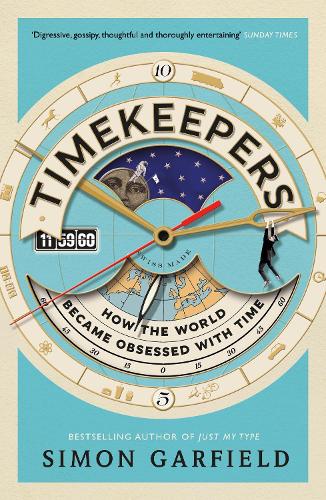
Timekeepers: How the World Became Obsessed With Time
Non-Fiction, Languages & Reference, Dictionaries & Reference, Science & Maths, Popular Science
Simon Garfield (author)
Paperback Published on: 06/07/2017
Price: £10.99