


Reviews: To Be a Machine (1)
“To Be a Machine”
(Paperback)
Simply put, the term “transhumanism” refers to the belief that “the human race can evolve beyond its current physical and mental limitations, especially by means of science and technology.” It is very much a domain in which science fiction influences science fact. In writing To Be a Machine, Mark O’Connell sought to answer the many questions raised by the theory of transhumanism. That is, how you would go about becoming a cyborg, how you might upload your brain into a computer so that you could live forever as code, whether artificial intelligence is likely to save or destroy humanity, how faith in technology could lead to the belief that immortality is achievable, what it is actually like to be a machine, and many more besides.
Fortunately for readers, his attempts to find answers result in a gonzo road trip down the global transhumanist highway. Like all the best road trips, O’Connell meets an unlikely bunch of eccentrics, dreamers and cranks, who are all united in their belief in the inferiority of flesh-bound humanity. He visits a cryogenic storage facility (you can opt for the full body freezing or just the head, depending on your budget), a sort of do-it-yourself body modification enterprise, the DARPA Robotics Challenge, Silicon Valley start-ups, various secret labs and numerous esoteric conferences. He meets academics, devotees, dot.com millionaires, engineers, self-taught computer buffs, a presidential candidate and the odd professional sceptic, all of whom are dedicated to furthering humanity’s understanding of transhumanism in one direction or the other.
A lot of the tech he is introduced to remains at the theoretical stage, although some of it seems quite plausible. For instance, instead of having to remember to put your Fitbit on every morning, you could follow the Grindhouse Wetware approach and have a vital functions tracker implanted under your skin. When it comes to our reliance on technology during day-to-day activities, maybe transhumanism isn’t quite as crazy as it initially sounds. Saying that, O’Connell notes in his conclusion that, at the time of writing, “no minds have been uploaded, no patients awakened from cryonic suspension and returned to life. No artificial intelligence explosion has taken place, no Technological Singularity.” People, whether transhumanists or otherwise, are still trudging toward death in their original, fleshy form. It’s not the most uplifting thought, which means it’s probably no surprise that some people turn to transhumanism in an effort to search for a better (or at least longer) future.
O’Connell makes it clear that he is not a transhumanist; he has no desire to live in their future, although he’s not always certain that he doesn’t live in their present. He believes, to some degree at least, in the central tenet of transhumanism, namely that “human existence, as it has been given, is a suboptimal system” and he’s keen to know what alternative systems might be available. Technology is developing at a rapid rate and it is undeniably playing an increasing role in all our lives. While not many of us are likely to become cyborgs or frozen heads in jars or consciousnesses trapped in a mainframe somewhere (and nor it seems do many of us actually aspire to such developments), it’s hard not to wonder what additional benefits technology can bring to us in the near future.
It’s this sense of wondering, whether half fearfully or wholly in awe, which makes O’Connell’s journey through the many facets of transhumanism so compelling. He certainly questions much of what is put to him during his journey (and some of it could definitely be described as questionable), but he doesn’t set out to mock or to debunk anything. There’s certainly a lot of humour in To Be a Machine, but O’Connell doesn’t seek to lampoon his subjects (and it would likely have been quite easy to do so), no matter how absurd their claims appear to be. He exhibits a healthy level of scepticism, but always lets the facts (or lack thereof) speak for themselves, and this allows for the presentation of all that is delightfully odd and frighteningly plausible in the world of transhumanism. His supremely readable account of the transhumanist movement is informative, somewhat alarming, thought provoking and highly entertaining.
Page of 1
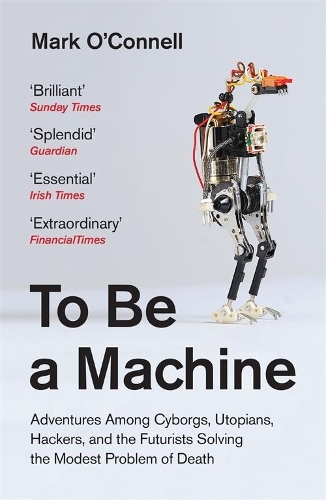
To Be a Machine: Adventures Among Cyborgs, Utopians, Hackers, and the Futurists Solving the Modest Problem of Death
Non-Fiction, Languages & Reference, Dictionaries & Reference, Science & Maths, Popular Science
Mark O'Connell (author)
Paperback Published on: 01/03/2018
Price: £10.99