


Reviews: We Do Not Part (52)
“Incredible”
(Hardback)
We Do Not Part is a beautifully haunting exploration of grief, memory, and human connection. Han Kang’s prose is delicate yet deeply affecting, weaving together fragmented narratives that blur the line between reality and dream. Her writing lingers like an echo, soft but impossible to ignore. This is not a story of resolution, but of absence and the ways love and loss become inseparable. Poetic, meditative, and quietly devastating, We Do Not Part is another stunning work from one of the most powerful literary voices of our time.
“I had not reconciled with life, but I had to resume living.”
(Hardback)
This book is a dream. It has a nightmare logic that pulls the reader deeper down into the abyss. It has a slippery quality to it. It feels like a branch has snapped somewhere off in the woods behind you, and you turn your head just too slow to make out what it is. Motifs circle around and push on the reader repeatedly, until it finally cracks open for you. It is a story that you feel in your body as you read, the cold seeping into you as well. The soft touch of feathers and snow. Intense but somehow calming at the same time.
A truly beautiful ode to love and memory. The relationship between our two main characters was like the shining light at the core of this book. What saves this book from being too sad to think about is how they are not alone in it. They have each other. This book holds your hand and pulls you all the way to the bottom of the sadness and horror, and in the calm shows that we must continue. That nothing ever leaves us fully. It is a haunting.
I feel lucky that I get to be alive at the same time as Han Kang. This is required reading. I will be re-reading again I'm sure.
Big thank you to Penguin for sending me a copy to review.
“Memorable, striking - a story that needs to be told.”
(Hardback)
What starts as a story of a friendship becomes a surreal journey through an almost monochrome, frozen landscape. Han Kang invokes the cold and silence perfectly. She uses snow to dramatic effect. The imagery is both beautiful and visceral, and scenic descriptions become striking allegories for something darker. The movement and interactions between characters are dream-like, bordering on supernatural. There's ambiguity as to who's alive or dead. What follows is the slow unwrapping of a mystery, uncovering a suppressed history of atrocities, a struggle to uncover truth and most of all, acts of remembrance. I found it quite a jolt that South Korea has such dark periods in its history. Not an easy read but memorable, striking and a story that needs to be told. Sure to cement Han Kang's standing in the world of literature even further.
“Another powerful work from one of world literature's finest writers”
(Hardback)
"People say 'light as snow'. But snow has its own heft, which is the weight of this drop of water.
People say 'light as a bird'. But birds too have their weight.
From the deserving winner of the 2024 Nobel Prize in Literature for her intense poetic prose that confronts historical traumas and exposes the fragility of human life.
We Do Not Part (2025) is the translation by e. yaewon and Paige Aniyah Morris of a novel by Han Kang, and a book that epitomises the prose and themes that led the Nobel Committee to choose here as the new Nobel lauraete (see below for their more detailed take).
This novel won the Prix Médicis étranger for its French translation and the English version must be a strong contender for a double-win for Han Kang in the International Booker.
The novel can be thought of as part of a trilogy linked by trauma, and by images of snow, with the powerful Human Acts and the exquisitely poetic The White Book (2017), both translated by Deborah Smith. I also believe this novel was originally going to be a short-story, the third of a a 'Snow Trilogy' with the two short stories, yet to appear in English, 'While A Snowflake Melts' and 'Farewell', as the narrator of this novel comments:
"I'd written a story titled 'Farewell', a story about a woman of snow who melts away under sleet. But that can't be my actual, final farewell."
Han Kang herself has described this book as a novel about profound love, and one that followed on from her experience after writing Human Acts as explained in the autobiographical opening to We Do Not Part.
We Do Not Part is narrated by Kyungha , a novelist, and the initial sections follow the author's own biography. Kyungha, like the author, completed a novel in 2014 based on the massacre that followed the May 18, 1980 Gwangju uprising. But far from purging each of visions of violence they were haunted by further dreams:
"Having decided to write about mass killings and torture, how could I have so naively - brazenly - hoped to soon shirk off the agony of it, to so easily be bereft of its traces?"
For both Kyungha, and Han Kang, this took the form of a very specific visual image, which opens the novel:
"Sparse snow was falling.
I stood on flat land that edged up a low hill. Along the brow of this hill and down its visible face to the seam of the plain, thousands of black tree trunks jutted from the earth. They varied in height, like a crowd of people ranging in age, and were about as thick as railway sleepers, though nowhere near as straight. Stooped and listing, they gave the impression of a thousand men, women and haggard children huddling in the snow.
Was this a graveyard? I wondered. Are these gravestones?
I walked past the torsos – treetops lopped off, exposed cross sections stippled with snowflakes that resembled salt crystals; I passed the prostrating barrows behind them. My feet stilled as I noticed the sensation of water underfoot. That’s strange, I thought. Within moments the water was up to my ankles. I looked back. What I saw astonished me: the far horizon turned out to be the shoreline. And the sea was crashing in.
The words tumbled from my lips: Who would bury people in such a place?"
She realises that this image isn't of Gwangju, and over time it leads her to another infamous massacre earlier in Korea's post World War II history, in the aftermath of the Jeju uprising on April 3, 1940, with up to 30,000, men, women and children, slaughtered by the US-backed mainland government forces, around 10% of the population, and a similar number fleeing to Japan.
In Korea this story was largely supressed during the military dictatorship, and the first literary treatment was in the 1978 novel by Hyun Ki-youn - Aunt Suni or Sun-i Samch'on in its English translations - which at the time it was published led to censorship and punishment of the author. There is, I think, a neat nod to this work when Kyungha's friend Inseon explains how to converse with Jeju people:
"Inseon had told me to address older people here as samchun. Only outsiders say ajossi or ajumoni, halmoni or haraboji, she said. If you start off by calling them samchun, even if you can't string together a sentence in Jeju-mal, they're likely to be less guarded, thinking you've lived on the island for a good while."
The other key character in the story is Inseon, a colleague from Kyungha's first job, like the author as a reporter at a magazine, over time a close friend, and an artist and film maker.
The novel rather jumps around in time but we learn than Inseon and Kyungha had conceived of an art-project which would be hosted on some land in the mountains of Jeju which Inseon had inherited, where they would replicate Kyungha's vision by planting one hundred black logs to resemble, and remember, those who lost their lives in 1948:
"I wanted to ask you – what if we did something about it together? I asked Inseon. What if you and I were to plant logs in a field, dress them in black ink and film them under falling snow?
Well, we’d have to get started before autumn ends, Inseon answered after listening to all I had to say. She was dressed in the black hanbok of mourning, her chin-length hair tied back with a white rubber band and her face earnest and composed. She said to plant ninety-nine logs in a field, we had to be sure the ground wasn’t frozen. She suggested we gather people to help with the planting by mid November at the latest, and said we could use the abandoned tract of land she’d inherited from her father, which no one used. Does the ground freeze here too? I asked. Of course, the uplands are frozen throughout the winter, she said."
Crucially Inseon's family home is away from the coast, as during October 1948 the government/mainland authorities decreed: “We impose quarantine on the area further inland than 5km from the coastline of Jeju Island and in the mountainous area from October 20 to the end of military action to sweep the unpatriotic extremists who committed unpardonable atrocities hiding in Mt. Halla”, with those in the interior subject to military action and execution.
But the right time to complete the project never quite comes, and Kyungha decides to abandon it, the two friends drifting apart. However, one December day she receives a simple text message from Inseon that simply reads Kyunghaya, the 'ya' a suffix used with close acquaintances. Inseon is in a hospital in Seoul, having severed her fingers in an accident in her Jeju studio, and asks Kyungha to visit her urgently.
It transpires that Inseon had been continuing with the project, indeed the accident came while working on the wood. She was rushed to hospital on the mainland for an operation to reattach her fingers, and she is desparate for Kyungha to go, that very day, to Inseon's Jeju home to feed the remaining one of her two pet birds, who she is convinced will not last another day without water and food.
Travelling to Jeju, Kyungha is caught in a snowstorm, which, give the journey involves the airport bus, followed by a local bus in to the inland and the slopes of Hallasan, and then a trek which would take 30 minutes at the best of the time, places her trip in some jeopardy, and indeed at one stage she falls down a slope, possibly losing consciousness briefly:
"This path I’ve landed on and slipped down by accident, this bed of earth in which I am lying, is most likely the dried-up stream. A thin layer of ice must have set over its channel, a pile of snow heaped up over that. There are hardly any rivers or creeks on this volcanic island, and only occasionally during heavy rains or heavy snow do flowing streams appear. The village used to be divided along the border of this ephemeral stream, Inseon once told me on a walk. A cluster of forty houses, give or take, had stood on the other side, and when the evacuation orders went out in 1948, they were all set on fire, the people in them slaughtered, the village incinerated."
She eventually recovers (or at least the novel narrates that she does) and finds Inseon's home, only to find that the bird she has come to save has already passed away, and she buries it, with the snow still falling heavily in the garden.
But the next day, when she awakens late in the afternoon, the bird seems to be back - and then she is also visited by Inseon, who she factually knows can not be there as she is still in the hospital. The second half of the novel takes on a dream-like quality as Kyung-ha is led by Inseon through various memories and archives of her family's history and the events in Jeju, which took place when Inseon's mother was 13:
"She told me about how, when she was young, soldiers and police had murdered everyone in her village. My mum had been in her last year of elementary school and my aunt was seventeen. The two of them had been away on an errand at a distant cousin’s house, which was how they managed to avoid the same fate. The next day, having heard the news, the sisters returned to the village and wandered the grounds of the elementary school all afternoon. Searching for the bodies of their father and mother, their older brother and eight year old sister. They looked over the bodies that had fallen every which way on top of one another and found that, overnight, a thin layer of snow had covered and frozen upon each face. They couldn’t tell anyone apart because of the snow, and since my aunt couldn’t bring herself to brush it away with her bare hands, she used a handkerchief to wipe each face clean. [...] That day, she came to understand something clearly. That when people died, their bodies went cold. Snow remained on their cheeks, and a thin layer of bloody ice set over their faces."
Inseon's great-uncle was arrested and then lost in the prison system, likely executed at the Gyeongsan Cobalt Mine although rumours persisted of escapees, and Inseon's mother went on to marry someone who did survive imprisonment. Inseon's mother also led a campaign to discover what happened to those caught up in the events, and her archives, which we explore with Kyungha and Inseon, also speak to events such as the 1950 Bodo League massacre, with Inseon's own films covering other atrocities, including those inflicted by Korean troops in Vietnam.
But at the heart of the story is the profound love which the author highlights of Inseon's mother for her family and between the two friends. And the symbolism of the snow:
"The snow that fell over this island and also in other ancient, faraway places could all have condensed together inside those clouds. When, at five years old, I reached out to touch my first snow in G—, and when, at thirty, I was caught in a sudden rain shower that left me drenched as I biked along the riverside in Seoul, when the snow obscured the faces of the hundreds of children, women and elders on the schoolyard here on Jeju seventy years ago, when muddy water flooded the chicken coop as hens and baby chicks flapped their wings and rain ricocheted off the gleaming brass pump — who's to say those raindrops and crumbling snow crystals and thin layers of bloodied ice are not one and the same, that the snow settling over me now isn't that very water?"
“Exquisite”
(Hardback)
Whenever I bring up Human Acts, most of the people I talk are surprised to hear that South Korea had, until very recently, a brutal history of suppression and violence against its own people. Hundreds of thousands were massacred by successive South Korean governments during and since the Korean War. Westerners often identify that kind of violence with North Korea, and, especially in the age of K-Pop and K-Dramas, it is hard to reconcile the glitzy image of the country with the sort of brutality Han Kang's books masterfully bear witness to.
We Do Not Part is a spiritual successor to Human Acts. It focuses on the afterlives of the massacres in Jeju Island during the 1948-49 uprising. Similar to Human Acts, Han Kang employs an innovative structure, but unlike Human Acts, the narrator and the narrative are not directly related to the uprising. The narrator is an author who has recently researched and written a book about a different uprising. Kyungha, the narrator, is suffering from the aftershocks of having experienced the traumas of the event they were writing about as a part of the writing process. Her friend Inseon experiences a terrible accident, and as a result her house in a remote part of Jeju is left unattended. Inseon asks Kyungha to immediately go there and care for her pet bird, who would die without a human looking after it.
The first half of the book follows Kyungha's meticulously written journey to Jeju through an enormous snowstorm. There is very little direct engagement with the main themes of the book in the first half. Han Kang masterfully writes quite an abstract narrative, weaving together the themes of dread, duty and fate. The second half confronts the Jeju uprising much more directly, as we follow Inseon's methodical research into her family's story. Part II reads almost like a journalistic investigation, providing a contrast with Part I, reminiscent of an arthouse film. The narrative is held together by a sense of foreboding and the haunting setting of the empty remote house. The novel really reminded me of Pedro Paramo: we follow an outsider coming into a deserted remote location possessed by its brutal past, everyone we meet might be dead already and the weather - sweltering heat in Pedro Paramo and the snowstorm in We Do Not Part - is a character in itself.
We Do Not Part is a novel about memory and human brutality. Han Kang revisits some of the themes of Human Acts, such as questioning who the memories belong to, critiquing extractive practices of interviewers, documentary filmmakers and oral historians, and discussing just how long a shadow events of the past can have. Folliwng Han Kang's Nobel Prize this year, many commentators were quick to point out that Korea ostracised Han Kang and now tries to reclaim her as a national hero, and having read We Do Not Part and Human Acts I can see why the government and the society at large would want to silence Kang's voice. She is absolutely unflinching in recovering the stories of the oppressed and questioning many narratives of Korean identity.
In We Do Not Part, one of the side plots concerns Inseon's documentary about atrocities in Vietnam committed by Korean soldiers fighting for the USA. In a memorable scene, Inseon, a Korean documentary maker, visits a remote village in Vietnam trying to interview survivors of sexual assault committed by Korean soldiers. Now an elderly woman, the survivor is pressured by others, including some Vietnamese, to tell her story, partially motivated by the fact that Inseon has come so far, from Korea itself, to hear her story. Kang brilliantly teases out the power dynamics and the complexity of bearing witness and documenting memories, as this old woman is pressured to relive what happened to her by someone from the country that committed the atrocity in the first place.
There are many brilliant moments like that in We Do Not Part. What I appreciate in it the most in the seamless merging of form and content. It does not just explore the themes and send a 'message' (although the factual message cannot be clearer). It is, first and foremost, a work of literary art, written in gorgeous prose conveying entrapping atmosphere. It is an achingly beautiful book for many reads and re-reads.
Thank you. NetGalley, and the publisher, for the review copy.
Page of 11
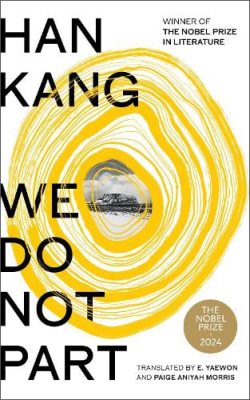
We Do Not Part
Fiction & Poetry, Modern & Contemporary Fiction
Han Kang (author) , e. yaewon (translator) , Paige Morris (translator)
Hardback Published on: 06/02/2025
Price: £18.99