


Reviews: Work (2)
“Very clear and lovely prose with witty asides”
(Hardback)
Work by James Suzman has an intriguing perspective and wasn’t at all what I expected. (And that’s definitely NOT a criticism!) The first question is: what is work? You and I might see pottering in the garden as a pleasant leisure activity but would someone employed and paid to work in someone else’s garden describe it in the same way or would they call it work? As Suzman says, “… the only thing that differentiates work from leisure is context and whether we are being paid to do something or are paying to do it.” I expected a fairly dry book that took us through the history of agricultural workers; factory workers’ conditions during the Industrial Revolution; the much more physically comfortable office jobs of today; and ending with predictions of what will be like in 50-100 years’ time.
I was sooooooooo wrong!
The book explores two main ideas. The first is the physicist’s concept of work as the transformation of energy. Do bacteria work? Plants? Carthorses? Suzman’s description of humans outsourcing some of their energy needs to flames and thus gaining leisure time is really thought-provoking.
The second strand looks at the cultural aspects of work. It is wide-ranging, covering the way in which we feel life has purpose when we work; the way in which communities form within cities, e.g. Brick Lane in London being famous for curry; and several other aspects. Suzman suggest that the mid-1800s “marked the beginning of many people viewing the work they did exclusively as a means to purchase more stuff”. Suzman’s writing is incredibly clear, making his complex ideas very easy to follow. With many science books, I often have to resort to a dictionary – but not this one.
I do like the low-profile witticisms such as low entropy states being “like children’s bedrooms when the children are forced to tidy up”. And I was enthralled by lovely bits of prose such as “the evolutionary dance that shapes the destinies of different organisms”. Suzman refers to the work of people like JK Galbraith and Frederick Winslow Taylor and his influence upon Henry Ford’s factory but he also draws upon less familiar names and research.
#Work #NetGalley
“This book leaves you pondering what the purpose of work is ...”
(Hardback)
When I read the “blurb” for this book, I was intrigued.
from the publisher: The book charts a history of "work" from the origins of life on Earth to our ever more automated present, challenging some of our deepest assumptions about who we are. Drawing insights from anthropology, archaeology, evolutionary biology, zoology, physics, and economics, he shows that while we have evolved to find joy meaning and purpose in work, for most of human history our ancestors worked far less and thought very differently about work than we do now.
Overall I found this an interesting read – there was new material that I had not encountered before, primarily in relation to the practices of the Ju/'hanse tribe who have been hunter-gatherers for generations. It is easy to think that our ancestors worked incredibly long hours, yet when we look at some of the examples given, we start to realise that people who work to live (such as the Ju/’hanse) often work fewer hours than those of in the “developed world”. It is interesting to ponder how the advances in the last 200 years in terms of machinery to “improve” production have really had an impact on the working lives of the people using them.
Many people in the modern world are working longer hours than their parents & grandparents and through the COVID pandemic, home & work have become ever more intertwined. Indeed, the hobbies people are starting to take up again with a “sustainability” or “eco-friendly” mindset are things that our ancestors considered work – sewing, knitting, growing vegetables, making wooden furniture … are we coming full circle?
It was quite academic, and heavy going/dry in places, but it is definitely a book that makes you think!
Disclosure: I received a copy of this book free via ThePigeonHole. Whilst thanks go to the publisher for the opportunity to read it, all opinions are my own.
Page of 1
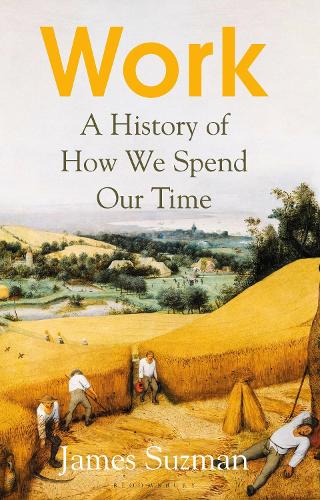
Work: A History of How We Spend Our Time
Non-Fiction, Education, Philosophy & Social Sciences, Social Sciences & Sociology, Social Sciences, Sociology, Science & Maths
James Suzman (author)
Hardback Published on: 03/09/2020
Price: £25.00